








Corporate, large-scale mining worsens climate change
3 MIN READ
By Arthur ALLAD-IW
www.nordis.net
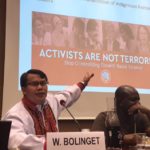
BAGUIO CITY – An indigenous federation in the Cordillera reported at the United Nations Permanent Forum on Indigenous Issues (UNPFII) that corporate and large-scale mining worsens climate change and calls for the moratorium on large scale mining and extractive industries in indigenous territories.
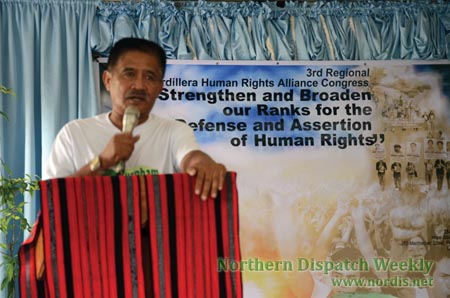
Citing the plunder and environmental destruction by mine corporations, Windel Bolinget of the Cordillera Peoples’ Alliance (CPA) addressed the Eighth Session of the UNPFII and recommended “a moratorium on large-scale mining and extractive industries in indigenous territories until mechanisms addressing outstanding issues are set, especially on compensation and rehabilitation of devastated communities and the urgent concern on climate change.”
The session started on May 18 in New York, USA, where indigenous peoples worldwide gathered to share their issues in Agenda Item 3 (a) on economic and social development.
Bolinget said that large scale mining worsens climate change and threatens the already vulnerable mining-affected communities.
“As mining operations are mostly in indigenous territories, indigenous peoples bear the brunt of the destruction of our lands and plunder of our resources,” he said.
Cordillera experience
He cited that in the Cordillera, the river systems were polluted due to toxic mine waste disposal as in the case of the Abra River and Agno River.
“Our historic and concrete experience shows that corporate and large scale mining did not push the country’s economic development and prosperity,” said Bolinget adding:
“Massive large-scale mining displaced and deprived traditional small-scale miners of inter-generational livelihood, led to the destruction of fertile lands, depletion of water resources, caused environmental and health problems, aggravated global warming and food insecurity.”
He revealed that there are pending mining applications covering 1.2 million hectares, of the total Cordillera land area of 1.8 million hectares. There are two on-going and active mine operations in the region, that of the Lepanto Consolidated Mining Corporations in Mankayan and Philex Mining Corporation, in Itogon and Tuba, all towns of Benguet.
Bolinget added that the extractive industry has also been a root cause of militarization and human rights violations. “Our assertions of our rights to self determination and ancestral lands are criminalized” as indigenous leaders opposing mining are slapped with cases in court, a tactic seen by communities to silence their growing opposition.
He added that in spite of the widespread nationwide opposition to large scale mining, the Philippine government under President Gloria Macapagal-Arroyo has aggressively liberalized the mining industry to attract foreign mining investments, as concretized by the National Minerals Policy and Mineral Action Plan.
“Its claims of promoting sustainable and responsible mining and development has been exposed as a barefaced lie,” Bolinget added.
Threatened Cordillera watershed
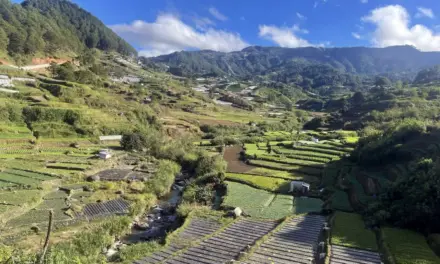
The Cordillera region is known as the “Watershed Cradle of North” upon which more than 1.8 million hectares of waterways and river basins, including 13 major rivers, across the downstream areas of the regions of Ilocos, Cagayan Valley, and Central Luzon are reliant, according to the latest North Luzon Inter-Regional Summit on water resources and environment.
While the government claims to protect the Cordillera watersheds due to its life support to the nearby regions, data from the National Economic Development Authority (NEDA) in the region shows that there are mining tenements within the declared watershed.
In these watersheds, approved Mineral Production Sharing Agreement (MPSAs) areas cover 13,167.12 hectares while exploration permit areas cover 10,522.02 hectares; while pending applications for Financial and Technical Agreements Areas (FTAAs) cover 729,996.3086 hectares while applications for Mineral Production Sharing Agreements areas cover 63,694.57 hectares.
Meanwhile, as his organization traced the mineral plunder of the resources from government laws and policies, Bolinget also called in the UNPFII session in New York the review and repeal of laws, such as the Philippine Mining Act of 1995, to be consistent with the United Nations Declaration on the Rights of Indigenous Peoples. # nordis.net