






Community, AFP talk on HR
4 MIN READ
By LYN V. RAMO
www.nordis.net
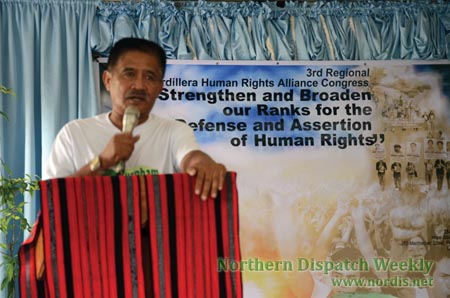
BAGUIO CITY — In a series of workshops that gathered state security forces and people’s organizations, hope remains high for a continuing dialog in the pursuit to protect and promote human rights.

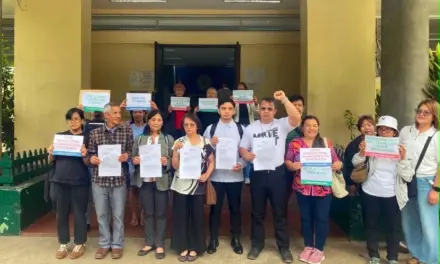
STANDING UP FOR PEACE. Hope remains high for a continuing dialog in the pursuit to protect and promote human rights. Photo by Lyn V. Ramo/www.nordis.net
Agreeing to disagree on a lot of issues and recommendations, officers and men of the military, the police, and their counterparts representing the Cordillera communities and human rights groups resolved that there should be continuing and joint discussions between them to come up with a common view on human rights and how to address human rights violations.
The mere identification of a human rights violator elicited heated discussions as there were recommendations from the people’s organizations, which were not accepted by the state forces and vice-versa.
“Everyone was apprehensive at the start of the dialog,” said Atty. Marlon J. Manuel, coordinator of the Alternative Legal Groups (ALG), which facilitated the community-based session on human rights promotion and protection at the Camp John Hay Igorot Lodge here Wednesday and Thursday.
According to Manuel, this is the fourth of a countrywide series of dialogs. The first three were in Davao, Naga and Ilo-ilo.
Not comfortable
“It is not easy talking to the military and the police on human rights issues,” Jude Baggo, secretary-general of the Cordillera Human Rights Alliance (CHRA) said apprehensively, considering that they were talking to the very people suspected of perpetuating injustice.
According to Baggo, CHRA maintains that elements of the Armed Forces of the Philippines and the Philippine National Police (PNP) are responsible for human rights violations because they are supposed to promote peace and protect civilians.
“The whole exercise is an effort and we are serious at coming up with ways to cooperate and find lasting solutions,” Baggo said.
CHRA, Cordillera Peoples Alliance (CPA), Cordillera Elders’ Alliance (CEA); Tongtongan ti Umili; Abra Human Rights Alliance (AHRA) Kakailian Salakniban Tay Amin a Nagtaudan (Kastan); Social Action Center, Episcopal Diocese of North Central Philippines (EDNCP) are among groups referred to in the forum as civil society organizations (CSOs) which represented Cordillera communities in the dialog.
CPA Chairperson Beverly Longid said, “It is very difficult (for us) to go into a dialog like this when we are considered front organizations of the Communitst Party of the Philippines and the New People’s Army.” Tagging of certain personalities active in organizations asserting the promotion and protection of people’s rights is one among many issues CSOs raised in the dialog.
Longid asserted the legitimacy of people’s organizations and challenged 502nd Infantry Brigade Deputy Brigade Commander Col. Jonas Sumagaysay to provide the CPA a list of suspected “party members” in the organizations’ roster.
Like Baggo, Longid is apprehensive of the turnout but she is hopeful the exercise started a long process of looking into and addressing hman rights violations.
Sumagaysay said he could not ask the Oplan Bantay Laya scrapping because it is the “AFP campaign to defeat the insurgents.” He said the CSOs may petition for its scrappage but “do not use me to bring the message to my superiors.”
State accountability
“The cases presented are still there (and remained unresolved),” Longid told the press in a brief interview shortly after the dialog Thursday evening. She said there was no unity on the definition of human rights and human rights violation, as she iterated the State, which perpetrates human rights violations, must be held accountable because it is responsible to protect, promote and guarantee the safety of citizens.
Among cases presented were the killing of farmer-hunters in the Cordillera on a mistaken notion that they were armed rebels; deployment of troops in areas where there are government-supported projects or business interests like mining operations; undermining of civilian authority during military operations; inefficient and ineffective conduct of investigations in human rights violation cases; continuous showing of the power point “Knowing Thy Enemy,” which identified legitimate people’s organizations as CPP-NPA fronts; and violent dispersals in rallies in urban centers and cities like Baguio City.
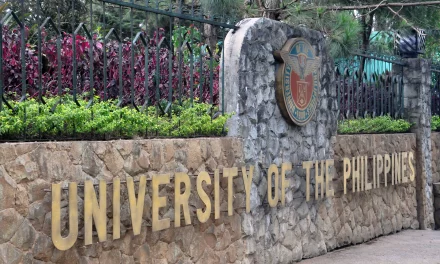
Prof. Celia Austria of the University of the Philippines Baguio presenting a framework to view human rights separately to the military and police and the CSOs, said in the Cordillera this should be viewed in the context of the people’s right to self-determination, the peoples’ right to their ancestral domain and the basic people’s right to life.
“Malaki ang responsibilidad ng ating pamahalaan sa mga paglabag sa karapatang pantao,” (The government has a great responsibility over the human rights violations) Austria told the military and the police, adding it is the government that sets policies, programs ad guidelines for its citizens.
Austria said the extra-judicial killings and enforced disappearances committed against Igorot masses and activists are just manifestations of the violations of their right to self-determination, right to life and right to ancestral domain.
“Any encroachment by corporate and government agencies into indigenous peoples’ territories is a violation of these rights,” Austria said, citing that the disturbance of the food web and the food chain because of these encroachments are in themselves human rights violations.
Optimism
Dialog coordinators, however, are optimistic of the success of the activity. Mary Anne Co, Hanns Seidel Foundation deputy head and program specialist, said the attendance of AFP and PNP commanders and those from communities speaks well of the activity.
Commanding officers of major Philippine Army brigades and provincial police directors were among the participants. Human rights officers of both the police and the military were also present.
“It is not easy to bring these people together,” Co told Nordis. “Even if they do not reach an agreement on several issues and concerns, the mere fact that they came over is success in itself,” she added.
Baggo said this is the first time that community organizations faced military and police in common workshop groups to unite on the issues and recommendations for the resolution of these issues. He said in previous dialogs, the contenders just presented their respective views.
Besides continuing dialog and education, the groups agreed to review “Knowing thy Enemy” and other materials.
CSOs recommended the implementation of the Melo Commission Report and the Phillip Alston Recommendations, but the military and police did not agree.
Co said there would be similar activities in other regions after the secretariat assessment in April. # www.nordis.net