








Abrenians fear losing their rice to mines
4 MIN READ
“Awanen! Uray adda pay koma’t magapas… no alaen amin ti minas dagiti taltalon, ania ngay ti mabalin dagiti mannalon?” (It is all gone. Although there are yet palay to harvest… if the fields would be eaten up by the mines, what is there left for the farmers?) one of three farmers of Baay-Licuan in Abra said to my disbelief.
In Baay-Licuan, some farmers do not only plant rice. They also go to the tunnels for gold. “No nakatalunen, mabalinen a mapan agusok,” (After planting, we could go to the mines) they said, insinuating they prioritize the rice fields to the mines.

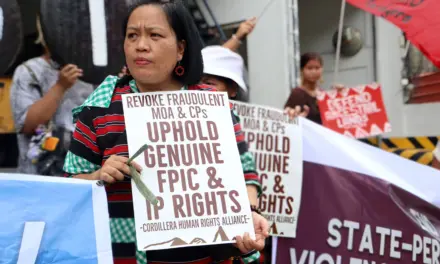
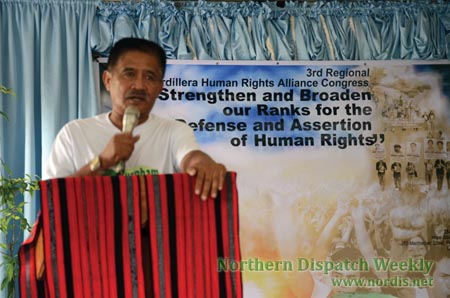
Abrenians participate during the Cordillera Day in Baay-Licuan. Photo by Noel Godinez/NORDIS
“Are you still planting rice up to now?” I was just curious, but the question reached them with a tone of surprise.
They started narrating before me that Abra farmers still have a lot to be proud of. They said they have a number of rice varieties indigenous to Abra. Some of these the farmers could not name because I was so excited writing all the names and the features of each rice variety they were enumerating impromptu.
Abra farmers still tend to balatey, which they consider the best rice variety there is in this rice-producing Cordillera province. Aside from balatey, other indigenous rice varieties as the gangkab, Bangkudo, pisla and balatinaw are still existent in the province.
I am only familiar with balatinaw, although the name connotes a variety of glutinous rice, usually required to make tapey (rice wine). In Pangasinan the variety is bato-linew, which my late grand ma would use to make tinurok, unda-unday or indikol, rice cakes which reminds me of my own childhood in the province.
The balatey, is a white rice variety, according to my farmer-friends from Baay-Licuan. Locals consider it best due to its sheen. “Nasileng a kasla namantikaan,” (It is shiny and seems oily) farmer Andres Belisario and Romeo Baroña said, almost simultaneously. They both agree that balatey is naimas (tasty) and nalukneng (soft) even when cooked several hours before meals.
“Uray makilabban, naimas ken nalukneng latta,” (Even when taken cold, it remains soft and tasty) Andres said.
The balatey plant grows almost one meter, according to Abra farmers. It could be harvested within four to five months from planting.
Like balatey, gangkab is also soft and tastes good. Its grains are short and rounded. “Kasla nabnabsog,” (It seems full) Romeo told me. Unlike the balatey, however, the plant is shorter and is often swarmed by pests.
“Isu’t paborito nga atakien dagiti insekto,” (It is a favoriteof insects) he said.
Bangkudo is the most pest resistant of all the indigenous rice varieties in Abra that farmers here like to plant it.
Pisla is not as soft as balatey. It tends to expand and needs more water to cook.
“Nabellad, isu nga adu ti pakanen na,” (It expands so it feeds more) Belisario said.
Balatinaw is sometime referred to as the black rice because of its dark color. It is considered one of the varieties locals call bayag (literally long wait) because it takes six months to harvest
Rice in Abra now commands a fortune. A salop would now normally cost P70 if one gets the whole cavan, which is around 20 salop or 50 kilos. Balatinaw, however, commands as high as P100 per salop. It is the most sought for, according to Romeo and Andres.
I realized, these are what the farmers in Abra would be losing once large mining operations get in their way. I suddenly felt uneasy hearing these news that a foreign mining company is hell-bent on getting the people’s consent to its operations.
How much are the locals losing to the mines? Invaluable rice fields, and the indigenous rice varieties, besides their very essence as indigenous peoples to the land of their ancestors.
I heard that 16 of the 27 towns in Abra would be covered by mining operations. In Baay-Licuan, alone, the site of the local government, Poblacion, is said to be in real danger if Olympus Mining is to start its operations. The mine site would be only two kilometers from the seat of government, and yet, locals do not see any action from the officials to stop the mines.
“Magaburan mismo ti Poblacion,” (Poblacion would be buried in mud) Ama Ernesto Quinto said. He chairs the Baay-Licuan Takderan Omnu a Karbengan (Balitok). He said, the mayor does not say anything, however.
“But you also go to the mines?” I asked again.
Many of us are small-scale miners, they would tell me with all dignity. In Baay-Licuan, at least four of 11 communities are engaged in mining which augments their income from planting upland rice. All barangays plant rice as a major crop.
The barangays Nalbuan, Tumalip, Bulbulala and Mapisla have majority of farming households also engaged in mining. A fifth barangay, Subagan, also have mining families but not majority of them do small-scale mining. Barangays Bonglo (Patagui), Cawayan, Domenglay, Lenneng, Mogao and Poblacion are purely agricultural with no mining households.
Baay-Licuan is a fifth class town. Abra, a 3rd class province is among the country’s ten poorest provinces. # Lyn V. Ramo for NORDIS