



Youthspeak: Mother Monster: She came, she saw, she conquered

July 29, 2012 in columns, Featured, opinion

By JUMAN KEVIN TINDO

“This is the manifesto of Mother Monster. On G.O.A.T., a Government Owned Alien Territory in space, a birth of magnificent and magical proportions took place. But the birth was not finite. It was infinite. As the wombs numbered and the mitosis of the future began, it was perceived that this infamous moment in life is not temporal, it is eternal. And thus began the beginning of the new race, a race within the race of humanity, a race which bares no prejudice, no judgment but boundless freedom,” so goes Lady Gaga’s opening words in her song “Born This Way.”

This song gave birth to the professed ‘little monsters,’ a group of people rooting and recognizing the message Lady Gaga is conceiving to the world. She is a queen, a warrior, a goddess, a sex symbol, and the so-called Mother Monster. However, her concert here in the Philippines raised many eyebrows from our Christian friends. They perceived her as immoral, satanic, and unethical. These harsh words were in every Filipino’s mouth as the concert of ‘Mother Monster’ approached.

Text messages encouraging everyone to boycott her concert went viral. It stated that Lady Gaga is a devil worshipper and mocks Jesus through her song Judas.

I myself became intrigued by this matter. I think that all those cruel words thrown at her are just a product of closed-mindedness, of people who do not have the appreciation of new art. For art’s sake, Lady Gaga is a symbol of positivity and individuality for all those out-of-the-norm people.

Even Lea Salonga wrote that Judas is a metaphor for people who seem to always find themselves attracted to what is clearly not good for them. And I agree with her. I also sometimes find myself in sync with those kinds of situation. That is the reason why I understand the way Lady Gaga dresses and interprets her songs, a reason why I understand her art.

I believe that every artist, whatever rubbish or jewel he or she produces, has the right to express his or her art- however outrageous or appealing it may be, and for whatever motive it may serve. The artist maintains his or her right to express his or her work, just like writing.

There’s an adage that always reminds us that art is in the “eye of the beholder.” How something registers artistically to us distinctly differs in so many ways. Whether it’s a painting, a dance, a song, or a live performance, one person could regard it as intellectual while another as a failed endeavor of art. Art is subjective.

If we remember last year, an art by Mideo Cruz was condemned by the Catholics. One of his works, Poleteismo, showed a giant wooden crucifix with a moveable bright red male organ. This artwork divided the opinion of Filipinos. Some applauded it; some condemned it.

The Philippines is still regarded as a conservative nation because majority of Filipinos are Catholics. Lady Gaga’s concert dealt with the same themes but not as critical as Mideo Cruz’s artwork. It tackled freedom of expression, right to be shallow, art, religion, and the modernizing global standards.

Lady Gaga stands for more than “grossly blasphemous, immoral, lewd and carrying demonic and occultist overtones.” These people said that Lady Gaga and her music have no place in this morally upright and Christian-oriented society. She is more than that. She stands for the equality of Lesbians, Gays, Bisexuals, and Transgenders (LGBTs) with the rest of the population. She advocates anti-bullying and, she campaigns for Acquired Immunodeficiency Syndrome (AIDS) awareness. She stands for advocacies which “Christians” sometimes do not give attention to.

What people perceive about her is their own business. They also have their right to express their own thoughts. You can love her or hate her. You can take pleasure in her music or not. You can even desire to protest her work if you don’t agree with it so as long as it doesn’t impede anyone else from liking her art.

Let us not suffocate artists, their inventiveness, and their privilege to convey themselves. Our country has a multitude of artists that we should be proud of. But, we must also welcome other artists from different nations to be a part of our happiness and pleasure of all things beautiful.

Of course, artists must be responsible for the art that he or she expresses. Yes, though we are in a democratic country, freedom of expression has a limitation. There are all types of audiences. There are those who can tolerate lewdness, those who are conservatives, and many more. But the point here is, we must give a chance for all artists, writers, painters, and everyone else the benefit of the doubt.

I think that despite all the differences in culture, religion, or how we perceive art, all must be open-minded. Lady Gaga has opened the doors of a world where people can be the same even with outrageous clothes and outfits through her songs.

“It’s not about the music, it’s about being yourself!” she exclaimed during her concert.

Through her, I became a ‘”little monster.” A member of a race which bares no prejudice, no judgment but boundless freedom. And I am happy that I am blessed with the understanding that art has its own beauty despite the theme it poses. # nordis.net

Share

Phoenix Cup opens basketball tourney

July 28, 2012 in Baguio City

By ARTHUR L. ALLAD-IW
www.nordis.net

BAGUIO CITY — The basketball tournament for the Cordillera Phoennix Sports Inc. (CPSI) Season VI opened on July 22 at the Easter College here with the participation of more or less 40 teams in the Baguio-Benguet area.
The tournament started with a program from 1 to 2:30 PM, followed by four games.

The activity was the sixth tournament sponsored by Phoenix, the organizer, which adopted CPSI when it was registered with the Securities Exchange Commission (SEC) in April this year.

In the program, the CPSI Board of Directors explained that they registered the organization as non-stock and non-profit to ensure the continuity of the tournament, including the transparency and accountability in professionalizing the tourney.

“We could also expand the tourney to high schools and sponsor trainings and seminars to improve the league, like coaching, refereeing, and players developmnent,” explained Clifford Sy, the CPSI chairman of the Board.

The Formation, a dance troupe of Easter College, also performed to the entertainment of the crowd which was covered by local media. #

July 22 results
Bracket E: UKOL 86 – Easter College BATCH Ninety Five 82
Bracket F: Burnham Suites 72 – Batch NINETY THREE 63
Bracket D: SHELL 92 – KAYLAKS 78
Bracket F: BBCCC 78 – HAZE 63

JULY 23 GAME RESULTS:
Bracket E: FONGWAN 75 – BATCH Ninety Nine 66
Bracket E: SANTISIMA 100-SMB 70

July 25 results:
Bracket F: 1906 EC 64 – Easter WEAVING 49
Bracket F: BENECO LINEMEN 78 – ALIED BANK 33

Share

Phoenix Cup Games for July 29

July 28, 2012 in Baguio City, Featured

GAMES on July 29 at the Easter College gym
10:00 AM – NINETY THREE VS ALIED BANK
11:30 AM – TSC VS FILAMBRI
1:00 PM – FOX VS FONGWAN
2:30 PM – BBCCC VS BURNHAM SUITES
4:00 PM – EC 95 VS SANTISIMA
5:30 PM – NTU VS BATCH 99
7:00 PM – JUSTICE VS BENECO READERS
8:30 PM – SKY CABLE VS GWE

Share

SONA protest in Baguio City

July 23, 2012 in Baguio City, Featured

By ALDWIN QUITASOL
www.nordis.net

Click here for more

Share

No clamor for autonomy

July 22, 2012 in Cordillera, Featured

By KIMBERLIE NGABIT-QUITASOL
www.nordis.net

BAGUIO CITY — The Cordillera People’s Alliance (CPA), the largest alliance of indigenous peoples groups in the region with over 200 member organizations, points out that there is no clamor for autonomy from the grassroots at the moment.

CPA Secretary General Abigail Anongos reiterated that at present what the people of the Cordillera wants is a stop to the devastation of the region’s environment by destructive mining and human rights violations brought about by militarization. She further reiterated that the autonomy bill being pushed in congress does not answer the the pervading issues the Cordillera people are facing at present.

“Without genuine recognition of indigenous people’s rights like by addressing current issues of development aggression and militarization, as well as sufficient awareness and people’s empowerment; the present third attempt at Regional Autonomy in the Cordillera may again be rejected,” she said.

Anongos also stressed that genuine regional autonomy which is the practice of self determination must emanate from the grassroots.

She pointed out that autonomy is embodied in one of the early popular campaigns of CPA for “Regionalization and Beyond”.

She explained that Regionalization aimed to unite Cordillera communities that are inhabited mainly by indigenous peoples to form an integrated region that will relate with the national government for administration, planning and services. Beyond, she added, is for the long term goal for regional autonomy as the expression of self determination for the Cordillera indigenous people.

She said the Regionalization and Beyond campaign was widely supported by the grassroots and even by professionals on a nationwide scale and the result of which is the inclusion of the provision for regional autonomy in the 1987 Constitution.

Anongos, however, stressed that the struggle for genuine autonomy is not yet over. “The fight for genuine autonomy has been at core of the CPA, the organization’s name alone says it Cordillera Peoples Alliance for the Defense of Ancestral Domain and for Self-Determination,” she added.

Benguet Vice-Governor Cresencio Pacalso in a separate interview maintains that thorough consultations at the ground level should have been conducted before the crafting and filing of an autonomy bill in congress. He added that in this way the sentiments of the people would have been gathered and included in the crafting of the bill.

“The information and education campaign being conducted now discusses the contents of the autonomy bill filed in congress where we are not even sure if the bill will be passed. Even if we have comments of suggestions how can we now include it in the bill when it is already filed,” he pointed out.

Pacalso added that autonomy is good because it will give more freedom to Cordillerans in governance and in the management of their own region. He, however, gave stress for a more thorough and proper consultations among all stakeholders during its crafting. He said that if proper consultations were done prior to the filing of the bill then majority of the issues being raised now should have been answered. “Maybe there would have been a more united stand if the consultations were done properly,” he added.

Dr. J. Prospero De Vera, vice president for Public Affairs of the University of the Philippines, who was the guest speaker in the Cordillera and Development Forum last July 12 also pointed out that the autonomy bill should be crafted well for it to be able to work. He stressed that there are already lessons for the Autonomous Region of Muslim Mindanao (ARMM) experience, which he called “an experiment that failed”.

De Vera was part of the technical working group that helped in the crafting of the law that created ARMM. He was also among those who evaluated the ARMM set up.

Among his suggestions was to put in the bill a more distinct definition of autonomy. He explained that the definition of autonomy would be different among various groups and political structure. He highlighted that consensus building among all stakeholders is necessary to be able to come up with a distinct definition.

“Autonomy has been framed as a struggle for self determination, do we have now a stronger consensus on what is self determination?…How do you reconcile the central government’s push for the mining industry and the clamor for the preservation and protection of your resources?” he asked.

He also suggested more study on the political structure as he pointed out that retaining the present political structure and creating a new regional structure is inherently problematic. He added that there should be provisions in the bill that will ensure that the regional autonomous structure will not just be another bureaucratic layer in the country’s political structure. “Problems with horizontal and vertical integration has been experienced in ARMM,” he said.

He was also emphatic on the inclusion of provisions that would ensure resource generation and transfer saying that a huge funding is needed to be able to make the autonomous set up work. He further said that there should be provisions on the distribution of funds among the provinces. He added that the funds should not be distributed equally among the provinces it should be according to the need of the provinces. “Those who have less development should have more funds,” he said.

When asked by members of the CAR drafting committee to improve the autonomy bill draft, De Vera committed to help coursed through the University of the Philippines Baguio. # nordis.net

Share

Sagada forms women rights defenders group

July 22, 2012 in Cordillera, Featured, human rights

BY ALMA B. SINUMLAG
www.nordis.net

BAGUIO CITY — In a phone interview with the Cordillera Peoples Alliance (CPA) Mountain Province, they announced that a Human Rights defenders group of women was just formed on July 19 in the municipality of Sagada with an objective to monitor violations on human rights and popularize the human rights campaign in the municipality.

Marcelo Daweg, chairperson of CPA-MP and District 2 coordinator of Katribu, said that the idea of having women HR defenders group in Sagada was first suggested by the women in the said area on March this year during a peace forum which was attended by Raffy Baylosis of the National Democratic Front of the Philippines (NDFP) and representatives from the Government of the Republic of the Philippines (GPh). Having an HR group for women was deemed necessary at that time in order to become a Quick Response Team (QRT) when there are human rights violations (HRVs) especially when it involves women, Daweg added.

Katribu Partylist, Tangguyob Peoples Center and the Asia Indigenous Peoples Pact (AIPP) facilitated the formation of the group. The formation activity was attended by 24 women from Sagada and one woman observer from Bontoc who is also part of the Intercommunity training project of the AIPP in empowering indigenous women in traditional customary institutions.

The said 24 women were all conveners of the group. Daweg further said that from the conveners, women voted for their officers. Josephine Lay-os from Bangaan of Northern Sagada is the chairperson with Josephine Say-awen of Patay, Poblacion as her co-chairperson. Also, Annie Sumedka from Barangay Ankileng is the secretary-general.

The officers and all the conveners have the responsibility to document HRVs by filling out fact sheets and formulating affidavits. They shall also lead fact finding missions (FFM) related to such violations. Part of their responsibility is to popularize among the indigenous women and the community as a whole the Comprehensive Agreement on the Respect of Human Rights and International Humanitarian Law (CARHIHL).

Daweg said that right after the formation of the group, they already planned their activities on the commemoration of the human rights day on December 10 and the women’s rights day on March 8 next year. One significant comment from the group is their appreciation on the formation in order to have a group defending their human rights because a lot of women in the municipality are not aware of having such rights.

Jane Faith Coteng, one of the staff of AIPP who was present during the formation of the group, said that the women were grateful that the group was organized and given the orientation on human rights.

It is to their advantage said the women to have a foundation to share and train their communities on their rights as women and as a people. # nordis.net

Share

PNoy’s EO hits SSM, boosts corporate mining

July 22, 2012 in Featured, mining, national

By KIMBERLIE NGABIT-QUITASOL
www.nordis.net

BAGUIO CITY — The new mining order of President Benigno “Noynoy” Aquino III, Executive Order (EO) 79 will adversely affect small scale mining (SSM) and further strengthen corporate and large scale mining.

Santos Mero, deputy secretary general of the Cordillera Peoples Alliance (CPA) reiterated that the new mining EO will kill the SSM industry as it gives more leeway to large scale mining companies for the plunder of the country’s mineral resources. He explained that the provision for the declaration of a Minahang Bayan in reality seeks to confine SSM to a very limited area as opposed to what the EO boasts of as a mere regulation of the industry.

Mero further explained that by limiting the areas for SSM, the EO has given large scale mining companies wider areas for maneuvering. He pointed out that areas identified for the application of a Minahan Bayan in the Cordillera are mostly with in mineral claims of large mining companies.

He said that CPA’s computations show that 1.2 million hectares of the 1.8 million total land area of the region is covered with mining applications including overlapping mine claims.

“The tables have now turned, the indigenous peoples are the ones seeking the consent of mining companies to mine the people’s own resources,” Mero stressed.

Mero also reiterated that the EO just reinforces the existing repressive mining laws such as the Philippine Mining Act of 1995 that has opened the country to large mining transnational companies for plunder.

“We reiterate our call to scrap the Philippine Mining Act of 1995 and the passage of a pro people mining bill to protect and preserve what is left of the country’s resources,” he said.

Mountain Province Governor Leonard Mayaen in an interview said that the new EO did not answer the problems with the SSM law which provides very stringent requirements for the declaration of Minahang Bayan area. “Compliance to the requirements of the Minahang Bayan are very hard to accomplish,” he reiterated. He added that SSM has long been a source of livelihood to many IP communities.

Mayaen also said he will support moves to question the EO for as long as it does not go against his position. “I have always been against large scale mining,” he said.

He further said that the Mountain Province provincial board already passed an ordinance banning large scale mining in the province.

Benguet Vice Governor Cresencio Pacalso in an interview admitted that there are many SSMs operating without permit in Benguet. “Local governments in the province exercise maximum tolerance knowing that SSM is a major source of livelihood to many of their constituents,” he said.

Pacalso, however, raised concerns on the impact of the EO on the province’s SSM industry. He explained that the EO has a repealing clause and it is possible for it to repeal the Presidential Decree 1899. He reiterated that the effect of the EO on PD 1899 should be clarified especially so that many SSMs in Benguet are operating on PD 1899 special permits.

PD 1899 was issued in 1984 by the late dictator Ferdinand Marcos which allows the granting of SSM special permits to individuals valid for two years and is renewable for another two years.

Faye Apil, regional director of the Mines and Geosciences Bureau (MGB) of the DENR in a press conference said the new EO does not ban SSM but seeks to strictly regulate it and confine it to one area for easier regulation and monitoring. She claimed that SSMs are confined in Minahang Bayan areas for easier management of mine wastes with the creation of central processing plants and tailings ponds for the protection of the environment.

She also assured that SSMs with valid permits will continue to operate but shall be subjected to the new EO after the expiration of their permits. She said that SSMs in the region are operating with special permits issued under the provisions of PD 1899.

Engr. Zards Gacad of the MGB said the EO will affect to a larger extent the SSM industry as he pointed out that the new mining order seeks to regulate it. He added that the MGB is also having difficulties in dealing with illegal SSMs. But he said that the impact on the SSM industry will be among those that the agency seeks to clarify before the issuance of the EO’s implementing rules and regulations (IRR).

MGB data shows that at present the region does not have any declared Minahang Bayan and has only one pending application which is in Bakun. # nordis.net

Share

Students march, demand higher education subsidy

July 22, 2012 in Baguio City, education

By PAUL SAMBAT and DELIA BAGNI
www.nordis.net

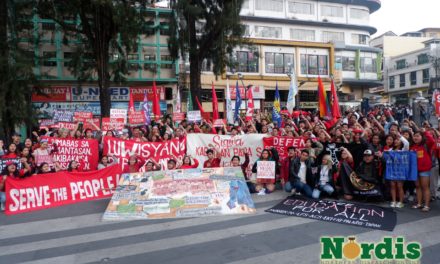
BAGUIO CITY — Students of the University of the Philippines Baguio (UPB) and other schools joined the nationally coordinated walk-out to demand greater state subsidy to state colleges and universities on July 18, 2012.

RAIN OR SHINE. The rain did not stop the UPB students from walking-out of their classes last July 19, 2012. The students demanded for an increase in the education budget. Photo courtesy of Ace Algre

The rain did not stop the members of UPB Context, Cadua, Alliance of Concerned Students (ACS), Anakbayan-UPB chapter, and Outcrop students’ publication among others from marching down from their school campus, Session Road to People’s Park. Around 600 students participated in the protest activity.

According to Regis Delos Rios, Anakbayan-UPB chairperson, the walk out is a symbolic action to oppose the latest tuition fee increase and budget cut on education.

UP student council Vice-Chairperson Forst Galang said that the walk-out is a big manifestation of unity among students of the universities in the pursuance of affordable and quality education.

He added that education should be accessible, there has to be an increase on the budget for education, a stop to tuition fee increase, scrapping of the Socialized Tuition and Financial Assistance Program (STFAP) and other demands of the students be heard. He said that the government should shoulder the fees of college and universities. “The students should not be the one to pay for all the tuition,” he said further.

The allocation for State Universities and Colleges (SUCs) in the national budget has been reduced to 1.7% or from 23.8 billion in 2011 to 23.4 billion this year. The proposed budget for 25 out of 112 SUCs was also decreased by as much as 23.4%.

Carlo Ipac of ACS cited an Article 14 of the Philippine contstitution stating “The State shall protect and promote the right of all citizens to quality education at all levels and shall take appropriate steps to make such education accessible to all.”

“Saan pupunta ang mga kabataan kung tataas ang tuition fee? Ang K+12 na programa ng presidente? Ang K+12 na yan ay ginagawang cheap labor force ang mga kabataan. Malaki ang potential ng mga kabataan sa pagpapaunlad ng bansa” (Where will the students go if the tuition fee continously increases? K+12 is making the youth a cheap labor force. Theres the big posibility that the youth is the key for the development of the country) says Ipac.

Meanwhile, Jessa Paquibot Editor-in-Chief of Outcrop, said that the TFI and budget cut are not the only problems that the SUCs are facing. According to her, reppression of campus press freedom is another problem that SUCs are facing.

Paquibot was sued by a UP instructor for libel. She said her case is a form of repression on student journalists. “This is not only my fight but the fight of all student journalists who suffered from reppresions and harassment. We, student journalists, should know our rights. And we are ready to defend it when needed.” She said that her case is still ongoing, the College Editors Guild of the Philppines (CEGP) gave their full support to her as well as the National Union of Journalist in the Philippines (NUJP). NUJP Secretary General Rowena Paraan came to Baguio to show their support and to help Paquibot.

The students said that if these TFI’s and budget cut continue, the students are not afraid to oppose it and they will organize more student actions to stop it . They will not stop until they achieve a lower tuition fee and a higher education subsidy. # nordis.net

Share

Bakun bid for Minahang Bayan remains pending

July 22, 2012 in Cordillera, mining

By DELIA BAGNI and KIMBERLIE NGABIT-QUITASOL
www.nordis.net

LA TRINIDAD, Benguet — The bid of the indigenous people of Gambang, Bakun, Benguet for the declaration of a Minahan Bayan is still pending with the Department of Environment and Natural Resources (DENR) for over a decade now.

Engr. Alfredo Genetiano of the Mines and Geosciences Bureau (MGB) Mines Management Division said Bakun’s application was filed in 1997. He said pertinent documents were already submitted and they are just waiting for the decision of the national office.

Genetiano pointed out that the region does not have any area declared as Minahang Bayan yet. He added that the application of Bakun is the only existing application for a Minahang Bayan in the region.

He, however, could not say what was holding the national office from processing and approving the Bakun Application. He said maybe the national office is still checking the viability of the application. He explained that the declaration of a Minahang Bayan is among the provisions of Republic Act 7076 or the Small Scale Mining (SSM) Act that transferred the management of SSM to the local government.

He further said that the Minahang Bayan application is part of the Ancestral Domain Sustainable Development and Protection Plan (ADSDPP) of the Gambang, Bakun folk.

ADSDPP as provided for in the Indigenous Peoples Rights Act (IPRA) is the development plan of an Ancestral Domain to support the indigenous peoples manage their domain.

Santos Mero, deputy secretary general of the Cordillera Peoples Alliance (CPA) in an interview said that the application of Bakun for the Minahang Bayan was not granted due to the opposition of Royalco Philippines saying that the peoples application falls within the company’s mining claims.

“The opposition of Royalco was the main reason why the application of the indigenous people of Bakun for the Minahang Bayan was not granted,” he reiterated. He added that Royalco on the other hand was able to push through with its mining exploration in Bakun despite the people’s opposition.

Mero highlighted that Royalco was able to secure certification precondition by circumventing the free prior and informed consent process in cohorts with officials of the National Commission on Indigenous People (NCIP).

“The indigenous people should be given priority to develop their resources for their needs however government agencies tasked to ensure the protection of the peoples rights fail to do so,” Mero reiterated.

Earlier reports showed that irregularities in NCIP’s conduct of the FPIC for Royalco’s mine exploration permit were validated in a consultation conducted by the House Committee on National Cultural Communities (NCC) headed by NCC Committee Chair Ifugao Representative Teodoro Baguilat, Jr. together with Bayan Muna Representative Teddy Casiño and Benguet Representative Ronald Cosalan. The consultation was held at Gambang, Bakun sometime February 2011.

MGB Regional Director Fay W. Apil during the regular session of the Benguet Provincial Board last July 17 disclosed that Executive Order (EO) 79 seeks to strengthen RA 7076 to regulate the SSM industry.

Apil said the mining EO reinforces RA 7076 provision that SSM should be operated within declared Minahang Bayan areas. “The EO also provides for the creation of a central tilling area to regulate the safety of the people and the environment,” she added.

She is hopeful that with the implementation of the EO the Bakun application would be granted. She added that her office is following up the application.

Apil together with Genetiano were invited by the provincial board to brief them on the new mining EO.

Benguet officials expressed apprehensions on the impact of the EO to the province’s SSM industry since there is no declared Minahang Bayan in the province. # nordis.net

Share

Philex union gears for local elections

July 22, 2012 in Cordillera

By ALDWIN QUITASOL
www.nordis.net

BAGUIO CITY — Union members of the Philex Rank-and-File Employees Union-Associated Labor Unions-Trade Union Congress of the Philippines (PRFEU-ALU-TUCP) in Philex Mines, Padcal, Tuba, Benguet are gearing for a petition for local election (LE) as they find their union officers not helpful to them.

According to mine worker Moses Fernandez, they have lost confidence in the union interim officers. He said that since they were appointed by the national office of ALU-TUCP in August 2010, they have yet to prove their leadership to the members. But until now, he continued that workers have barely felt the presence of these officers.

The only general membership assembly the officers initiated he said was when they let the union members ratify the first Collective Bargaining Agreement (CBA) between the union and Philex Mining Corporation (PMC). He also said that the CBA negotiation seem to have even been kept secret that the members were only informed that there was such when they came to know about the ratification. He said the union also did not ever consult the members on the union’s CBA proposals so that they can also suggest matters that will be beneficial to the members.

Fernandez said PRFEU got the union leadership after beating the National Mines and Allied Unions(Namawu) -local 101 in the Certification Election (CE) on July 19, 2010.

According to him, the union officers are silent on every issue that affects the union members. He said there were many labor cases that were not being attended to by the officials. The officers only promised their members that they are following up the cases. He added that there were members who were unjustly terminated by the company and yet the union made no appropriate actions.

Fernandez also complained that the officers are letting their members sign a blank paper without any cover letter or letter head. He said that when they asked what is the signing all about, the officers told them that it is for their back pay from their retroactive benefits indicated in the first CBA of PRFEU and PMC to be released.

But when he demanded and read a letter from the officers who were letting them sign, he observed that the letter stated that it is an acknowledgment that they had already received their benefits. He said this was suspicious.

Fernandez said further that they are demanding for their copies of the CBA. But they were only told by the union that there was only one copy. He said the members have the right to be given copies and know the content of the CBA.

“Itatta nga agsagsagana ti unyon para iti renegosasyon nu next year para iti nabatbati a dua a tawen ti CBA, kayat mi a sukatan dagidiay opisyales mi ta awanen talek mi kada isuda,” (Now that the union is preparing for a renegotiation next year for the last two years of the CBA, we want to change our leaders because we do not trust them anymore) Fernandez said in Iloko. He added that when their petition for local elections will materialize, they will see to it that they will campaign hard for the leaders they find trustworthy. # nordis.net

Share

Health group hits CHR decision on harassment

July 22, 2012 in Cordillera, human rights

By CHESTCORE (PR)

BAGUIO CITY — The Community Health Education Services and Trainings in the Cordillera Region (Chestcore) condemned the Commission on Human Rights-Cordillera Administrative Region (CHR-CAR) for declaring the nine cases of threat harassment and intimidation against health workers and volunteers “closed and terminated.”

In an emailed statement, Romella L. Comia Rasalan of Chestcore called CHR-CAR useless after declaring their complaints closed with finality. She reiterated that CHR failed to fulfill its mandate of protecting and promoting human rights.

Rasalan pointed out that the CHR decision undermined the dangers and trauma the Chestcore staff and volunteers went through when they were put under surveillance and received death threats. She added that the decision limited the principles of human rights in a purely legal framework.

“It also downplayed the dangers of its declaration of certain communities as “red areas” and the vilification of development workers like us, continuously making us open targets of human rights violations. It negated the human rights context of Cordillera communities who are eking out their survival and sacrificing lives in their continuing historical struggle to defend land and resources against development aggression pushed by the state,” the statement further read.

The CHR decision dated June 20 declared the case of harassment and unjust vexation filed against certain John Does Manaois, Galera, Enriquez and Raton of the Philippine Army filed by Chestcore staff and volunteers Fatima Sabaten, Renay Maguinsay, Rosalinda Suyam and Rene Balintao “closed and terminated”. This was after the victims appealed for CHR to reconsider its earlier decision on March 9, 2010.

It can be recalled that CHR in its earlier decision dismissed the same case due to lack of merit despite the absence of counter affidavits of respondents. In the said decision CHR cited that the area where the incident happened was declared as a “red area” and that the incident does not constitute a case of harassment and unjust vexation as defined and penalized by law.

In its recent resolution, CHR reiterated that a case could not be filed against the respondents as it recognized that the soldiers’ actions were unwarranted. “Sadly, however, despite these findings this office could not recommend filing of a complaint of Unjust Vexation against respondents because the same light felony prescribing two months was allegedly committed sometime on June, 2007 and thus has already prescribed.”

Rasalan further pointed out that there is a systematic attack against community health workers in the country. She condemned these attacks and demanded justice for all the victims. “We raise our fists in protest and demand for justice for our colleagues,” she stressed.

Among the cases Rasalan mentioned was the recent killing of Willem Geertman, the Dutch executive director of Alay Bayan Luson, Incorporated (ABI)last July 3. She said that Geertman is have been actively participated in based. She added that he was also at forefront of protests against large-scale mining.

She also mentioned the ambush of Dr. Chandu Claver and family in Kalinga in 2009. Dr. Claver survived the attack but his wife died of fatal gunshot wounds. On the same year, two doctors were also killed followed by a slay attempt on Ronald Capitanea, a communityin Negros Occidental in 2010.

Other cases include the illegal arrest, detention and torture of 43 health workers in February 2010. The said health workers were released 10 months after as a result of protests and political pressure on the Aquino government. November 2010, Leonard Co, the country’s most famous botanist, was killed in Leyte, by soldiers of the Armed Forces of the Philippines (AFP) as attested by witnesses and evidence.

Rasalan said the Philippine government’s failure to eliminate extrajudicial killings, torture and enforced disappearances despite being a party to human rights instruments and international convention at the Universal Periodic Review at the United Nations. She stressed that CHR-CAR’s decision is yet another example of this failure.

She added that the CHR-CAR decision helped the perpetrators and not the victims and has reinforced the culture of impunity tolerated by the present administration. She added that the same decision also aided the smoother implementation of the deceptive internal security plan of the government the Oplan Bayanihan that serves as a blanket of protection over elements of the AFP in guarding and protecting big foreign business interests devastating and plundering the region’s resources adversely affecting the health and lives of the people.

“The CHR-CAR leaves us to our own recourse in the protection and assertion of our rights. now rise, together with our communities, as we strengthen our ranks to further pursue our struggle to assert the people’s right to health,” the statement ended. # nordis.net

Share

Cordillera youth for a progressive culture

July 22, 2012 in Cordillera, people

By DELIA BAGNI
www.nordis.net

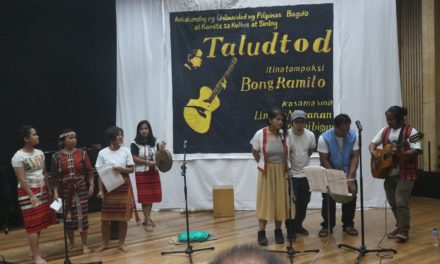
BAGUIO CITY — Cordillera youth cultural performers met with the elders in a cultural exchange enhancing their knowledge on the traditions and basic guidelines on ethnic dances.

Dap-ayan ti Kultura ti Kordilyera (DKK) Chairperson Matyline Camfili said that many of the Cordillera youth cultural performers of today do not know how to dance the traditional dances the proper way. She lamented that a lot of cultural dancers make fun of the Cordillera dances and treat them as just for entertainment. She added that the real essence of these traditional practices and rituals are not being presented well.

DKK spearheaded the cultural exchange program as part of its month long activities in celebration of the cultural organization’s 21st anniversary. The activity was participated in by different Cordillera youth organizations such as the Panagtignay dagiti Nakurapay nga Agtutubo para iti Tarigagay ti Umili a Demokrasya-Anakbayan (Pinatud), PAYYEW, DANUM, Tanghalang Bayan ng Kabataan sa Baguio, Salidummay, Mana-o, and members of the Bontoc, Ifugao, Benguet, Apayao and Kalinga (BIBAK).

Camfili said that the cultural exchange also aims to equip the participants’ additional knowledge and skills of performing.

Composer Mauricio Patungao said the youth should be aware of the social realities of today and present it through the arts. He shared that music can be a way of struggle for the eradication of social illnesses such as corruption among others. He said it can also be used for healingand for peace. He added that the youth must learn to play indigenous instruments on proper occasions.

Marlo Killip Pinatud cultural performer said that the activity is good as they learn the proper way of representing Cordillera culture. He also said that they were able to forge cooperation with the other cultural performers in the City of Baguio.

DKK Secretary Mia Butoeg said that the activity was scheduled on Satrurday and Sunday to accommodate all youth who are studying.

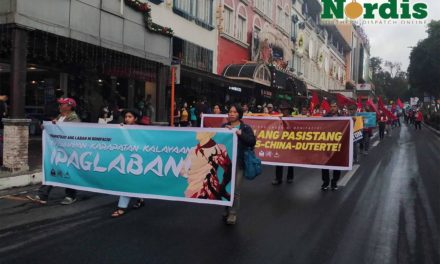
On July 23, DKK members and allied organizations will join the march-rally and a program at People’s Park during the 3rd State of the Nation Address (SONA) of President Benigno Aquino III. A cultural concert will follow in the afternoon. # nordis.net

Share

CPLA no longer exists

July 22, 2012 in Cordillera

By KIMBERLIE NGABIT-QUITASOL
www.nordis.net

BAGUIO CITY — Regional Peace and Order Council (RPOC) Chair Ifugao Governor Eugene Balitang in an interview declared that the Cordillera Peoples Liberation Army (CPLA) no longer exists.

“As to the RPOC, CPLA do not exist anymore, they are supposed to be a changed group,” he stressed. Balitang explained that the signing of the closure agreement marked the end of the group’s existence.

The Ifugao governor further said the Regional Development Council relegated to the RPOC the resolution of the issues of two CPLA factions. The factions include the Arsenio Humiding and Marcela Bahatan and the Miguel Sugguiao and Andres Ngao-i.

Jovencio Balweg of the Cordillera Elder’s Alliance (CEA) and the brother of CPLA leader the late Fr. Conrado Balweg in an earlier interview pointed out that the issue on the said group should have ended a long time ago since they are already a part of the Armed Forces of the Philippines (AFP). He said the group is now just a para-military group serving as security guards for politicians and warlords.

Samuel Anongos, Spokeperson of Katribu Partylist reiterated that the CPLA is not worthy of such recognition and should instead be punished for the crimes it has committed against the people. He pointed out that members of the said para-military group have been involved even in many crimes.

Anongos also reiterated that CPLA admitted to the abduction and disappearance of Cordillera People’s Alliance (CPA) Vice Chairperson Daniel Ngayaan and the murder of CPA Coordinator Romy Gardo in 1987. He added that Ngayaan remains missing to date. He also mentioned that the convicted gunmen who killed journalist Rey Pedronio were CPLA members. Pedronio wrote about and exposed the illegal activities of the group.

Baguio officials in 1999 declared the CPLA persona non grata in Baguio City. Sometime last June, Vice Mayor Daniel Fariñas reminded CPLA members during a council session that they were never welcome in the city and told them to stop meddling in land problems and demolition of houses in the city.

It can be recalled that the closure agreement between the Government of the Philippines and the Arsenio-Humiding faction of the CPLA and the Cordillera Bodong Administration (CBA) was singed at the Rizal Hall in Malacañang sometime July last year.

The Balweg faction however did not take part in the earlier closure agreement. The Office of the Presidential Adviser on the Peace Process (OPAP) is currently talking to the said faction for another possible closure agreement.

Balitang added that the RPOC is willing to help in the negotiation with the other faction that refused to take part in the closure agreement if they are asked to. # nordis.net

Share

OPAPP identifies “conflict drivers” in IP areas

July 22, 2012 in Cordillera, national

By KIMBERLIE NGABIT-QUITASOL
www.nordis.net

BAGUIO CITY — Land dispute, rights violations and mining are the leading root causes of conflict or as the government call it conflict drivers in Indigenous Peoples’ (IP) territories in the country.

This was the findings of the Office of the Presidential Adviser on the Peace Process (OPAPP) in the conduct of their conflict assessment workshops.

According to Annaliza Laylo, the Peace Program Officer of OPAPP, the conflict assessment for Cordillera was held last April 13 here in Baguio City.

Laylo disclosed that overlapping land claims, boundary disputes, non-recognition of rights and mining also figured as the leading conflict drivers in the region. She added that clan wars and tribal wars are among the conflict drivers identified in the workshops.

OPAPP Assistant Secretary Howard Cafugauan explained that conflict assessment workshops are held to identify the conflict drivers in the areas identified for the implementation of the Payapa at Mayaman Pamayanan (Pamana) project. He added that the conflict drivers must be identified to address the issues properly and prevent resurgence of conflict.

Cafugauan hopes that the results of the workshops will influence the planing and programming of local government units (LGU). He said projects in the past were planned without the benefit of assessments of situations on the ground and that in the end the projects did not resolve the root causes of conflict.

Regional Peace and Development Council Chair Ifugao Governor Eugene Balitang explained that Pamana is part of the closure agreement between the government and the Cordillera Peoples Liberation Army (CPLA). He added that Pamana projects are implemented in identified as CPLA areas.

Balitang further explained that some Pamana projects were also identified in the Kalayaan Barangay Projects during the Arroyo government being implemented by the Armed Forces of the Philippines (AFP). He said the KBP projects were later shelved when the Aquino administration assumed office and now the AFP suggested that a closure first of KBP projects and reconciling them with the identified Pamana projects to avoid duplication of projects.

He pointed out that the RPOC meeting held last July 18 at the Hotel Supreme was an offshoot of the June 29 meeting when the issue on the KBP projects were raised by the AFP. He, however, said the issue is still unresolved because the final list of projects is yet to be accomplished by OPAPP.

“Hopefully the issue will be resolved in our third RPOC meeting,” he said.

Pamana Cordillera program for 2011 to 2012 has a total funding of P263.575 million for 118 projects. Out of the said funds Abra got a total of P46.8M for 11 projects, Apayao P34.8M for 16, Benguet P11.1M for six, Ifugao P52.5M for 26, Kalinga P43.8 for 39 and Mountain Province P52.5M for 19 projects.

Pamana projects include community infrastructure and livelihood programs. # nordis.net

Share

Anti-mining network nabukel idiay Adams

July 22, 2012 in Ilocos, mining

By DONNA RABANG PETA
www.nordis.net

ADAMS, Ilocos Norte — Nabuangay ti Salakniban ti Adan wenno Salakniban ti Adams ken Daga a Nagtaudan idi July 14 ditoy kas sungbat dagiti umili iti tuloytuloy ken umir-irteng nga isyu ti panagminas iti lugarda.

Inatendaran daytoy dagiti umili ti Adams, manipud iti sektor ti simbaan, Nainsigudan nga umili, mannalon, kababaihan, driver’s association, tourist guides ken daddumapay.

Nabukel daytoy nga alyansa iti tenga ti agresibo a panangallukoy ti National Commission on Indigenous Peoples (NCIP) ken Benguet Corporation kadagiti umili iti Adams nga umanamong iti panagserrek ti dadakkel a minas.

Naitakder daytoy nga alyansa lima nga aldaw kalpasan a pinirmaan ni Presidente BenignoAquinoJr. ti Executive Order 79.

Sakbay a pormal a pinasingkedan dagiti organizing committee ti pannakabukel ti alyansa, natalantan ti isyu ken kasasaad ti panagminas iti Ilocos Region partikular iti Ilocos Norte. Ditoy met laeng a naibingay dagiti baro a damag no ania dagiti kumpanya nga agtartarigagay nga agminas iti Adams.

Dagitoy nga updates ken kasasaad ket imbingay ti People’s SolidarityAgainst Large Scale and Destructive Mining in Ilocos Norte (PSALMIN).

Inted met ti Ilocos Human Rights Alliance(IHRA) ti oryentasyon mainaig iti Karbengan tao.

Makatulong daytoy nga oryentasyon kadagiti umili no kasano a sangoen ti ipakaseknan iti isyu ti karbengan da iti daga kas nainsigudan nga umili ken kas tao ken nakasilpo iti isyu ti panagminas.

Maysa a linaon ti oryentasyon daytoy nga alyansa ket “ipursigi ken ipasaknapna ti pannakabukel ti tukad- munisipal a panagkaykaysa dagiti umili tapno salakniban ken saluadan ti biag, daga ken kinabaknang iti Adams, bambantay, kabakiran ken karayan.

Agserbi ti alyansa kas sentro ti impormasyon ken kampanya kontra iti panagminas, panangsalaknib iti nagtaudan ken karbengan tao.”

Naipangruna met laeng iti partikular a plano ti alyansa ket panangala iti nalawa a suporta para kadagiti aktibidad ken kampanya nga isayangkat da iti lokal ken probinsyal, makitipon wenno makisilpo kadagiti nadumaduma nga organisasyon ken network a mangitantandudo iti pagsayaatan ti aglawlaw ken pangtao a karbengan kas ti PSALM IN. # nordis.net

Share

Baguio mayor pushes barangay merging

July 22, 2012 in Baguio City

By ALDWIN QUITASOL
www.nordis.net

BAGUIO CITY — Baguio City Mayor Mauricio G. Domogan stated during his Weekly Ugnayang Panlungsod that the city government is planning to push through with the merging or the lessening of the 129 barangays of Baguio.

He said Baguio City acquired the number of its barangays before to get more funding from the National Government. He cited Manila City who have more than 800 barangays.

According to Domogan, when there was still no Local Government Code (LGC) or Republic Act 7160 and the funds of Baguio City as well as of the barangays are being appropriated by the Malacañang. He explained that at the time cities or towns with more barangays get more funding from the national government. He said for example if each barangay is allocated P2,000 and if a City had only 5, then that city will only be given P10,000.

He explained further that local officials then created more barangays even if the areas are not qualified. “Isunga adda dagidiay luglugar nga uray limlima laeng ti balay idiay, naiproklaman a barangay tapno ad-adu ti ipresentar da idiay National Government,” (So there are areas that had only five house holds but were proclaimed as barangays in order to have more to the national government) he continued.

He said that after the passage of RA 7160 in 1991 and funding of the barangays are now up to the city governments. He added that city officials are now having a hard time appropriating funds because of the large number of barangays. He also said that some of the barangays with lesser area and population are at the disadvantage. So to solve this he said, the number of Baguio’s barangays should be reduced.

On the other news, the mayor said that city officials will have a meeting to discuss the upgrading of the Real Property Tax of the city. He said that the current market value of real properties was not adjusted since 1996. He said further that there is a need for upgrading property tax as the city faces more expenses.

Domogan cited the garbage collection fees pegged at P20. He said that the City government is only collecting around P11 million while spending over a hundred million on waste management. He said he requested the presiding officer of the Sangguniang Panlungsod to tackle the matter in their regular session. # nordis.net

Share

DOST introduces OL trap to combat dengue

July 22, 2012 in health

By ALDWIN QUITASOL
www.nordis.net

LA TRINIDAD, Benguet — Citing the municipality of La Trinidad which has the highest recorded dengue cases in the Cordillera region, Department of Science and Technology (DOST) Benguet Provincial Science and Technology Center Director Arnold Inumpa suggests the further utilization of the Mosquito Ovicidal/Larvicidal Trap (OL trap) to control the population of the dengue-carrying Aedes mosquitoes.

Inumpa said that the OL trap is developed as part of the government’s effort in addressing the rising cases of dengue especially this rainy season.

According to Inumpa, the OL traps retards the growth of the larvae. He said, by the use of this, 90% of the larvae trapped will not prosper into mosquito. This he said will curb the development of Aedes mosquitoes population.

An OL trap has three parts according to Inumpa; the black container, a small strip of lawanit wood measuring 1 inch by 6.5 inches where mosquitoes will lay eggs on and a larvicide solution.

To use the OL trap he said first put 250 milliliters of tap water into the black container, pour one sachet of OL pellets on the water for the larvicide solution and then put the lawanit stick with the rough surface facing up.

He added that the OL trap should be placed in a low lying area and should be protected from sunlight and rainfall. He said let the OL trap stand for six days and make sure that the surroundings of the container is clean so that the mosquitoes will lay their eggs on the trap only. After six days he said, gently brush off into the solution the mosquito eggs stuck on the lawanit strip and pour boiling water into the container and dispose the contents on dry ground.

He said the OL trap is very affordable and only the larvicide pellet would be bought because the other two materials can be improvised. He said a sachet of pellets costs P1 only.

However he said, the pellets are not yet available in Benguet. Mass selling of this kind he added is available only in the province of Bulacan. But he said they are looking for ways to make the solution available to the people of La Trinidad and other parts of the region. # nordis.net

Share

Editorial Cartoon

July 22, 2012 in editorials, Featured, opinion

Share

Editorial: Who’s the boss?

July 22, 2012 in editorials, Featured, opinion

www.nordis.net

It has been two years since Pres. Benigno Aquino III (PNoy) took the nation’s helm and declared that everyone get in line behind him as he would lead the nation on the straight path (daang matuwid) to progress, or something like that. Come Monday afternoon, the President is again expected to deliver his state of the nation address before Congress. On the other hand, it is also expected that progressive and militant groups would deliver or give out their evaluation of the incumbent’s service to the nation in their traditional version of the ‘parliament of the streets’.

In this region that has a major population of indigenous peoples — who for many generations through the Spanish and American colonizations to the present western style of governance — have fought for the recognition and respect of their ancestral domains, ancestral lands, culture and chosen resource management.

It has been 25 years since Republic Act 8371 (Indigenous Peoples Rights Act) has been promulgated but still the indigenous peoples rights to their ancestral domains, ancestral land, and the right to self-determination continues to be mangled by powers that be in attempts to disenfranchise them. One such practice can be seen through the state agencies’ process of the peoples’ right to free, prior, informed consent where community people are purposely divided by covert misinformation and surreptitious monetary rewards so they may give up their fight to preserve their traditional sources of livelihood and natural resources.

The government’s implementation of the FPIC process is opposed to what PNoy said in his past SONA. And to quote PNoy, “Papaigtingin namin ang proseso ng konsultasyon at pag-uulat sa taumbayan. Sisikapin naming isakatuparan ang nakasaad sa ating Konstitusyon na kinikilala ang karapatan ng mamamayan na magkaroon ng kaalaman ukol sa mga pampublikong alintana.” (We will intensify the process of consultations. We will strive to implement the rights guaranteed in our Constitution, including the right of the people to information.)

Furthermore, when the people rallied to make their opinions heard about weaknesses in government policies, they are answered with threats from the state security forces. Cordillera and other indigenous peoples’ leaders are among the victims of extrajudicial killings who under PNoy’s watch has claimed 99 people (including two foreigners namely Fr. Fausto “Pops” Tentorio and Willem Geertman), political arrests and detention of more than 100, and the practice of torture and enforced disappearances continues.

Impunity still prevails as evidenced by the records that not a single soldier, police officer or government official has been tried nor convicted for human rights violations. Clear manifestations of PNoy’s government is the indifference to the pleas for justice. Human rights groups say PNoy’s administration has made no effort to search for and surface the victims of enforced disappearances like in the case of James Balao.

The struggle for the protection of the ancestral domain and resources has actually made the indigenous peoples domains, including vast resources of the Cordillera, last frontiers of natural resources that the nation can depend on to mitigate effects of the global phenomena of climate change, global warming or the greenhouse effect. Resources that the people can build on for food security and sustainable environments. Instead of conserving and developing these resources for his people, who by international standards are a very poor lot, Pnoy says: “We will cut red tape dramatically and implement stable economic policies. We will level the playing field for investors and make government an enabler, not a hindrance, to business.” He meant for the stronger foreign capitalist, also called the imperialist.

The PNoy government neglected to protect the advantage for his people but has been opening up more opportunities for foreign corporations and their local counterpart through its public-private partnership projects, often at the expense of the poor Filipino majority.

The Filipino people thought PNoy referred to the poor Filipino majority, indigenous peoples and Igorots included, when he said, “kayo ang boss ko.” But after two years in office on his own and with no more Gloria to blame, the broken promises and numbered accomplishments of this administration to alleviate poverty and improve social services to the Filipino, who do you think he was referring to as his boss? # nordis.net

Share

Advocate’s Overview: Projects for hazard prone areas

July 22, 2012 in columns, Featured, opinion

By ARTHUR L. ALLAD-IW
www.nordis.net

The rains have already started. More heavy rains and typhoons are, in fact, natural occurences. As of this writing, heavy rains had shown its strength. And waterways, like canals and drainage, cannot seem to contain these waters anymore. I’ve seen waterways turn into river during a heavy down pour as the canals are too small to accomodate the rain waters.

A study by experts from the DENR’s Mines and Geos-Sciences Bureau (MGB) showed that the country is hazard prone. Various natural indications were raised on why the Philippines is a hazard area. The archipelago lies within the Pacific ring of fire where tectonic movements are active. There are numerous active faults and trenches where volcanic belts and active volcanoes are found. Naturally too are mountainous terrains and steep slopes.

We are also located in the area where numerous typhoons and extended rainy seasons are a natural reality. We are included in the area considered the pathway of a large number of tropical cyclones. The study shows that the Philippines experience about 20 storms and typhoons in each year.

Of course man-made initiated activities contribute to the natural hazard prone situation of the country like the silted rivers and clogged waterways, sub-divisions that flatten mountainous areas and covered natural creeks and rivers, denuded forests among others.

Very interesting in the study is about their findings that the Cordillera region is a geo hazard area. It identified that the region as prone to earthquake, landslides, floods and hazards in the Karst area (due to natural development of sinkholes and underground streams in limestone areas. In fact, all the Cordillera provinces and the city of Baguio area are on the top lists of landslide prone areas.

Concretely as a landslide prone area, the past typhoons showed that the region, particularly Baguio City is a landslide prone areas. Reports from the CDRCC showed there were loss of lives every time we have storms and heavy rains.

Naturally, the study pointed out that about 90 percent of the region is classified as steep to very steep. As such, it is liable to unstable and more mass movements. Removal of vegetation, like sub-divisions do, contribute to its being a landslide prone area. Overload of slope surfaces is identified as a trigering factor too.

The experts said that despite the Cordillera being landslide prone, structural mitigations can be adopted to control these landslide areas. These include infra-structure projects like rib concreting and rip-rapping to strengthen weak areas.

Waterways and drainages projects must be assured inorder that water would not find its ways to areas that can easily soak and slip or cause landslides.

This study is very appropriate in our area, in the city particularly. However when you look at the infra-structure projects being done by officials today, they are not geared toward addressing our being prone of landslide, flood, and earthquake. Instead of projects that would strengthen weak areas prone to landslides, these officials instead destroy good roads. Almost in every part of the city, good roads are destroyed for new repaving. These “bakbak doon, bakbak dito” moves are not only a waste of people’s money and inconvenience to the public. These projects are not the priorities for a hazard prone area. Will these officials ever learn? Or are these on-going good roads being re-paved anew a big source of their profit? Just asking! # nordis.net

Share