



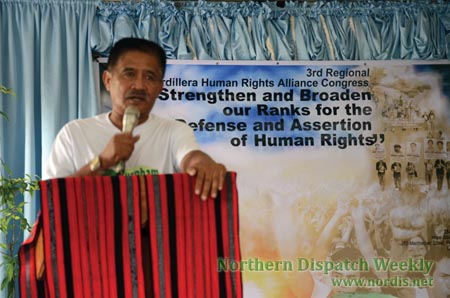







Human Rights confab renews commitment

July 31, 2011 in Cordillera, Featured

By KIMBERLIE NGABIT-QUITASOL
www.nordis.net

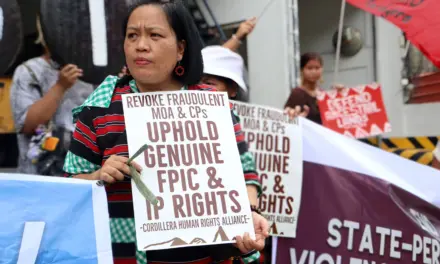
LAGAWE, Ifugao — Human rights defenders under the banner of the Cordillera Human Rights Alliance (CHRA) successfully staged their third regional congress on July 28 to 29, here just as the group weathered the murderous and violent Oplan Bantay Laya (OBL) of the past regime and braved the passing typhoon Juaning.

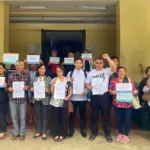
IN SOLIDARITY. The Ifugao Youth Alliance opens the solidarity night of participants to the CHRA congress. A night long cultural presentations as part of renewing their strength and unity for the defense of human rights. Photo courtesy of Audrey Beltran

In the said congress the membership of CHRA assessed their programs, celebrated their victories, recognized their shortcomings and renewed their strength to continue the struggle for peace based on justice with the recognition that the sorry state of human rights persists under the more deceptive counter-insurgency program of the new administration of President Benigno Aquino III, Oplan Bayanihan.

CHRA Secretary General Jude Baggo stressed that human rights workers with the organized sections in the region have undoubtedly foiled the Gloria Macapagal-Arroyo regime’s counter-insurgency program, OBL I and II.

He added that human rights organizations including CHRA courageously confronted the violent and murderous OBL, and remained resilient amid extrajudicial killings, enforced disappearances, strategic lawsuits against public participation (SLAP) and the continuing surveillance and harassment against human rights defenders and activists.

“Despite this victory, it is true that some of us chose to side step, go back to their home towns and leave the country. Our principles and commitment were shaken. We feared for our lives and lost our spirit of volunteerism. But today, in this congress, as we can see, we have regained our strength and resolve to continue the fight. We did not stop,” Baggo stressed in Iloko.

He further said that Cordillera human rights workers did not stop from building their capacity to respond to human rights violations through education and trainings for documentation. “We continued to document, expose and oppose rights violations and militarization.

We militantly freed our colleagues who were illegally arrested and falsely charged by state security forces,” he added.

Baggo pointed out that with rights violations continuing under PNoy’s Oplan Bayanihan, it is but right for Cordillera human rights workers to continue to strengthen their ranks through building stronger grassroots human rights formations to face and beat the new counter-insurgency program.

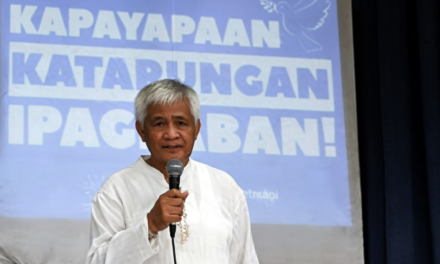
In his keynote address, Roneo Jigs Clamor, Karapatan secretary general highlighted that CHRA carried on the legacy of the Cordillera peoples historical resistance to state plunder and repression.

“Indeed, your history has shown the Filipino people and the world that political repression, state terrorism and exploitation will not be countenanced by the peoples of the Cordilleras,” Clamor said.

He reiterated that the proud legacy of Cordillera martyrs has carried forth CHRA to its third assembly with renewed strength and resolve to defend the people’s rights in the face of a more deceptive state counter-insurgency policy that mouths respect for human rights but continues to violate the peoples rights.

“The CHRA, as with all other organizations of human rights defenders, has had its share of sacrifices in serving our people, especially in the defense of our peoples’ rights. Karapatan is all the more proud to stand with you in the promotion, protection and defense of these rights,” Clamor reiterated.

Ifugao Congress Representative Teddy Baguilat Jr., in his message of solidarity, commended CHRA on its third regional congress as he assured his commitment and support to the struggle for the respect and recognition of human rights.

Baguilat also pointed out that CHRA’s program is timely and worthy of support for the challenges facing human rights advocates today are more severe and more complex.

He also highlighted that the tedious task of educating and defending human rights needs more workers and advocates.

“…How can we win more soldiers to the side of human rights advocacy? I cannot provide you with answers to that question. But as your representative in Congress, it is my duty to support your campaign with an environment conducive to gaining more advocates,” Baguilat said. # nordis.net

Share

Katribu condemns abduction of Aggay leader

July 31, 2011 in Cagayan Valley, Featured, human rights

By ALMA B. SINUMLAG
www.nordis.net

BAGUIO CITY — Katribu partylist strongly condemned the abduction of an Aggay leader in Rizal, Cagayan by joint elements of the Armed Forces of the Philippines (AFP) and the Philippine National Police (PNP).

Beverly Longid, president of Katribu, in an interview said this is the 3rd time that Aggays are subjected to human rights violations (HRVs) in the span of less than five months.

In data gathered by local human rights defenders, it was stated that on July 23, Saturday, Vicente Agbayani, 48 years old, resident of barangay Masi, Rizal, Cagayan belonging to the Aggay tribe (Indigenous Peoples in Rizal, Cagayan) was tortured and abducted by the members of the Charlie Coy of the 17th Infantry Brigade of the Philippine Army (IBPA) and the Regional Mobile Group (RMG) of the PNP.

Agbayani, according to the report was working in their kaingin (slash and burn farm) with his wife, Salomea when suddenly, the perpetrators arrested him without a warrant. “Hindi lang hinuli kundi sinak-tan, binugbog at piniringan ng mata,” (He was not only arrested. He was even tortured physically and blindfolded) the report read.

The report added that Agbayani did not know of any reason for the state forces to arrest him. His wife who is pregnant was even hit. Witnesses were quoted that they had seen Salomea blood bathed. Salomea chose to follow her husband to where the armed elements brought him.

Still based on the report, he was brought to the town center of the municipality of Lasam, Cagayan. Also, witnesses said that Agbayani was abducted because the military accused him to be a member of the New Peoples Army (NPA).

The report further stated that the 17th IBPA with more or less 50 elements backed-up by the RMG has, since July 21, been conducting joint combat operations within the municipalities of Sto. Niño, Piat, Rizal and Lazam.

Agbayani, aside from being one of the Aggays in Rizal, is also a farmer leader. He is the leader of the Timpuyog Dagiti Man-nalon nga Aggay iti Zinun-dungan Valley and at the same time leader of the Katribu Chapter in the said valley.

In an interview, sources said relatives and neighbors of Agbayani went searching for him for days. They found him in the Bureau of Jail Management and Penology (BJMP), Tuguegarao City charged with five counts of multiple murder and two frustrated murder for allegedly being part of the ambush that killed five police officers in Rizal.

“We condemn the extra legal actions of the military against an innocent Aggay for there was no valid reason for them to arrest him, and even more to subject him to torture.” Longid said. This, she said, is the 3rd time that the Aggay community is terrorized by a joint AFP and PNP combat operation, and make false accusations against these civilian indigenous peoples to be members of the NPA.

She recalled that last March, a family of Aggay were shot by the soldiers while they were gathering food along the Sierra Madre mountains. One member of the family was killed. This she said was because they said they suspected them to be members of the NPA.

Moreover, she also recalled that on March this year, a 10 year old boy belonging to the B’laan tribe in Sarangani was forced by the military to carry arms and had taken pictures of him.

These violations Longid said are clear evidence that there is no change in the AFP system. “Ito ang sinasabi nilang Bayanihan?,” she exclaimed. She added that with the HRVs experienced by their IP brothers and sisters, the Oplan Bayanihan is no different from the past anti-insurgency program, Oplan Bantay Laya I and II that had took the lives of more than a thousand activists.

She also called on fellow IPs specially those in the countryside to be vigilant, the Oplan Bayanihan is deceptive and its implementors are armed and in search of an enemy, opening the unsuspecting civilian population vulnerable to human rights violations.This she added might be worse than the OBL I and II. # nordis.net

Share

MPSPC faculty, parents call rallyists to go back to school

July 31, 2011 in Cordillera, education, Featured

By ALMA B. SINUMLAG
www.nordis.net

BAGUIO CITY – Parents and faculty of Mountain Province State Polythecnic College (MPSPC) called on the protesters to resume their classes while waiting for the result of the investigation.

In an emailed statement entitled “An urgent appeal to faculty and students: Go back to class and let the investigation be,” they expressed their sympathy to the students with legitimate issues raised particularly on their democratic rights. They also salute said students for actively asserting their rights to expression.

Moreover, they expressed their concern to their co-faculty raising issues like permanency, honorarium, process of hiring and firing, and promotion.

They also strongly suggested the students and faculty to come together and collate the cases of threats, harassments and intimidation specially committed in the duration of the rally.

However, they are alarmed that the students have not attended their classes for a month already. “They missed a lot of lessons in the so many days that classes were suspended and disrupted,” the statement reads.

The topics that have not been lectured, they said, have piled up to more than two pages modules and hand-outs. They are also worried about the computer and laboratory classes and on-the-job trainings that hand-out instruction would not suffice.

Classes outside the school

Mau Bartolome, the spokeperson of the concerned teachers, also called the protest leaders to stop harassing members of the faculty and students that are going back to class. In a phone interview, she shared that she had experienced being locked by the protesters in the classroom with her students while having their class. “Until now, harassment by the protesters is continuing,” she added.

Because of this, Bartolome said that they are resorting to conducting classes outside the school. “May nagkaklase sa Bontoc Plaza, provincial library at pati sa mga bahay,” (There are those that are having their class at the Bontoc Plaza, provincial library, and even in houses) she said.

She also raised their concern on the welfare of the faculty on job order basis that are being payed per day and the part-time instructors who receive pay per hour. If classes continue to be disrupted and worse if the school shuts down, the non-permanent faculty members will no longer receive their dues. “They will no longer have a source of income to feed their families,” their statement further reads.

They stressed that they (faculty) are accountable to the students, parents and the community. Parents who are sending their children to school, Bartolome added, are hoping that the students are learning. “If classes will not resume, the students and their parents are the ones who will suffer the most,” Bartolome added.

They are calling the attention of the student leaders, concerned faculty members, administrators and their community leaders to encourage each and everyone to resume classes as they wait for the result of the investigation of the issues raised against Dacyon’s administration.

“Let due process prevail,” said their statement.

Moreover, they are calling the help of concerned agencies to intervene so that the situation will go back to normal. This, they said, will give way for the investigating team to do their part in solving the problems and issues brought out.

They are also hoping that the investigating team will conduct an impartial investigation.

Meanwhile, concerned parents of the students of the said school in an emailed open letter are asking the leaders of the protest to have mercy on their children and let the classes resume. They also expressed their doubt that the problems raised by the rallyists can be solved if Dacyon will resign.

Moreover, they called the leaders of the protest to study their actions and consider the welfare of their children. # nordis.net

Share

Health group threatened anew

July 31, 2011 in Cordillera, human rights

www.nordis.net

BAGUIO CITY — A day before the PNoy’s State of the Nation Address (SONA), a staff of the Community Health Education, Service and Training in the Cordillera Region (CHESTCORE) received a threat on her mobile number again.

At about noon on July 24, Sunday, Milagros Ao-wat received threats from cell number 09093118024 indicating close surveillance on her whereabouts and activities.

“Ingat kau, labas kau ng labas kasla kayo met gamin sigsiguro. Apay dayta trabaho yo mano ti bayad no matay kayo. Parangal laeng met.. ay ay ay. Narigat ti mabrainwash ta haan nga makita ti usto,” (Take care, you are always going out, you are very daring. Why? How much will you get from your work when you die? Only a tribute … ay ay ay. It is hard to be brainwashed because you cannot see what is right) one text message read.

This was followed by another saying, “Sinowak? Haan masapul ti nagan ko. Ammoyo met nu cno dagiti agininteresado kadakayo. Kuna yo nga iharharas mi dakayo,” (Who am I? You don’t need to know my name. You know very well who are after you. You said that we are harassing you).

“Threats continue. Nothing has changed despite Pnoy’s promise of a ‘matuwid na daan’! ,” Romella Liquigan-Rasalan, the Executive Director of CHESTCORE said. The group she said strongly condemns the continuing assault on their staff and their institution inspite of their continuing resolve to render health services.

In earlier reports, Ao-wat, a CHESTCORE staff member revealed to have received several death threats last December, 2010 and January, 2011 on her phone.

“The threats have not stopped. This is appalling because what we do is provide much-needed health services and yet, this is what we get,” Ao-wat said.

“We have already reported this to the Commission on Human Rights. They have yet to bring out their report on the past cases and now, there are new threats,” Rasalan added.

March this year, CHESTCORE launched a campaign to stop the harassment of Cordillera health workers as it exposed continuing threats that happened on staff and volunteers when in Baguio and during field work since 2007.

The campaign aimed not only to expose the threats but to help assert people’s right to health. CHESTCORE, a non-government health institution founded in 1981, has been serving far-flung Northern Luzon communities which are not reached by government health services or where these are insufficient. Unfortunately, instead of being commended for their work, CHESTCORE has been accused of being New People’s Army (NPA) supporters or their staff accused as being NPAs themselves.

“This is not really surprising even if people pinned much hope for change under this administration,” Jude Baggo, the secretary-general of the Cordillera Human Rights Alliance (CHRA) said. PNoy he added has launched his Oplan Bayanihan last December 2010, an anti-insurgency program that includes among its features the vilification or the tagging of progressive organizations as underground organizations.

“This has replaced then president Arroyo’s Oplan Bantay Laya that accounted for the more than 1000 extra-judicial killings among militant groups” he added.

“But this has to stop!,” he stressed. Thus, he said they highlighted CHESTCORE’s case in their Assembly last July 28 & 29 in Ifugao especially in the launching of their anti-vilification campaign.

CHESTCORE and CHRA vowed to put in greater efforts in this campaign to gain broader support in these cases and to stop continuing human rights violations in the region. # CHESTCORE Release

Share

Red spokes says PNoy rule a failure

July 31, 2011 in Cordillera

By ALDWIN QUITASOL
www.nordis.net

BAGUIO CITY — In a statement sent to the media, the spokesperson of the Cordillera People’s Democratic Front (CPDF) said the miserable situation in the region of Ilocos and the Cordillera mirrors the dismal state of the country a year after President Benigno Simeon Aquino III took office.

According to Simon “Ka Filiw” Naogsan, PNoy’s empty promises are reflected in the continuing violations and betrayal of the people’s right to land, livelihood and resources. “The real boss of the Aquino administration turns out to be not the Filipino people but US Imperialism as it furiously expands its economic interests as well as large scale corporate mines and geothermal and hydroelectric power projects in Northern Luzon and rams down the nation’s throat its Oplan Bayanihan (OPB), the so-called internal peace and security plan,” Naogsan said. He added that these worsen the national oppression against the indigenous peoples of the nation that has reached an ethnocidal level.

Naogsan said that the “daang matuwid” slogan of PNoy is no different from the substandard Halsema Highway with its erosion and slides, close-open status and serving mainly foreign interests in extracting super profits from the Cordillera region’s resources.

Naogsan lambasted the Oplan Bayanihan of the Aquino rule saying that despite its deceptive features, it is fast showing up its true character compared to the Oplan Bantay Laya 1 and 2 of the previous administration. He explained that the old tactic of “divide and rule” is being applied to exploit indigenous social, economic and political systems in its counter-insurgency operations.

“They target not only combatants but more so innocent civilians including minors and the elderly. Coining nice sounding contraptions to hide the harshness and vileness of Oplan Bayanihan does not succeed in erasing the notoriety of the AFP as armed units of the ruling class,” Naogsan said further.

The CPDF spokesperson also mentioned that in Aquino’s administration further ruin of hinterland communities of the region can be expected with over half of the Cordillera covered by various mining permits and exploration applications. “The mining operations of the US giant mining company, Phelps Dodge in Patiacan, Quirino, in Ilocos Sur and Batong Buhay, Pasil, Kalinga; Lepanto’s nine front companies planning to drill in 311,853 hectares more in 29 municipalities across six provinces; the 33 mining applications covering 292,600 hectares criss-crossing Abra; as well as Nickel-Asia’s take-over of the 194,640 hectares covered by Cordillera Exploration/Anglo-American Exploration all make a mockery of the Free Prior and Informed Consent (FPIC) process,” Naogsan explained.

Naogsan added that since the National Commission on Indigenous Peoples (NCIP) makes it a point to invent and recognize organizations of elders that eventually grant FPICs despite opposition from genuine peoples organizations, the provisions of the Indigenous People’s Rights Act (IPRA) has become a mechanism that acts as a milking cow for the corrupt bureaucracy.

Naogsan also criticized PNoy for its intensified implementation of the dole out Conditional Cash Transfer (CCT) known as the Pantawid Pamilyang Pilipino Program (4Ps) that, according to him, insults and turn productive forces into beggars. He said that with much funds already spent, the health conditions and school infrastructures in the 49 CCT areas in the region have not yet improved and have even deteriorated. “Even in the province of Benguet, ironically one of the five richest provinces in the country and also a CCT recipient, one out of three schools do not meet the minimum standard of one seat for every student. As much as 20% of the P20 billion earmarked for CCT nationwide goes to trainings, additional staff and printing of manuals and not to the actual beneficiaries – a source of corruption for the DSWD,” Naogsan furthered.

Naogsan said that the shifting of political alliances strengthens the administration coalition but has brought warlord wannabes. “This early, politicians have sought to consolidate control and influence over stakeholders, wherein even a state college president has been a victim of vicious ploys to replace the position with a lackey of the incumbent Congressman,” he added.

Naogsan also said that a third attempt to push for an organic act creating a bogus Cordillera Autonomous Region to further co-opt political leaders and speed up the exploitation of its rich natural resources. He explained that regional autonomy is meaningless and counter-productive when political power is controlled by imperialism and the elite classes of landlords and the corrupt officials as well as criminals, opportunists and hypocrites. According to Naogsan, regional autonomy can only be achieved if the nation is free from foreign domination and free from oppression.

Naogsan also hit PNoy’s administration for cuddling the Cordillera People’s Liberation Army (CPLA). “The Aquino regime seeks to resuscitate the comatose CPLA in order to project some progress in the peace talks that it currently sabotages thus stalling the Government of the Philippines (GPH)-National Democratic Front of the Philippines (NDFP) peace negotiations,” he added.

Naogsan said that despite these, the progressive legal mass movement has made significant strides in defending the land, livelihood and resources and the rights of the indigenous people. He said that militant delegations are being staged whenever there is rampant abuse by the military.

According to Naogsan, the Aquino administration failed miserably. He said that there is no clear cut difference between the present rule and the past administration of Gloria Macapagal-Arroyo. “As in all the previous regimes, the Aquino regime in its first year in office failed to address but instead continued to perpetuate the historically rooted issue of national oppression being suffered by the national minorities of the Cordillera,” he said. # nordis.net

Share

PNoy’s SONA disappoints Baguio group

July 31, 2011 in Cordillera

By ALMA B. SINUMLAG
www.nordis.net

BAGUIO CITY — “Walang pagbabago sa panahon ni Aquino,” (There is no significant change in Aquino’s regime).

RICE AND SAYOTE LUNCH. Baguio multisectoral groups gathered at the Peoples’ Park to hear PNoy’s SONA on July 25 had a worker’s lunch of sayote and rice an actual illustration of the growing poverty a reality painted over on the president’s address delivered hours after. Photo by Kimberlie Ngabit-Quitasol

This was the cry of the Baguio multi-sectoral group after the 2nd State of the Nation Address (SONA) of President Benigno Aquino III today, July 25 at the Peoples park where around 200 people gathered for a public viewing of the president’s delivery of his SONA.

Tracy Dumalo of Anakbayan – Cordillera said PNoy has not done anything that is in favor of the education sector. “Tuluy-tuloy pa niyang binawasan ang budget sa edukasyon kung saan ito ang pinakamalaking paraan kung paano niya sinagkaan ang quality and affordable education,” (He had cotinuously decreased the budget for education which is his way to suppress the quality and affordable education) she added.

She even said that PNoy is probably living in the world of fantasy. This was in relation to PNoy’s statement that his administration has provided 1.4 million jobs since 2010, .8% decreased in unemployment rate and many more. “Nabubuhay siguro siya sa pantasya dahil kabaligtaran naman ng katotohanan ang kanyang sinasabi,” (His statements are contrary to reality) she pointed out.

The first part of PNoy’s speech was on the poverty incidence in the country, he says has decreased by 15.1%. This was met by audience’s disgust indicating that it was a lie.

She explained that PNoy has not correctly addressed the problems in the country. His answer she said to poverty is Public Private Partnership (PPP). This she added is another form of privatizing the industries and basic social services. His answer to unemployment she said is the migration of labor force.

Moreover, she said PNoy’s answer to the peoples call to pull out the military forces in the country sides is the deployment of more state forces. This is evident she added with the map that was displayed that almost in all the provinces of the Cordillera are deployed by the Armed Forces of the Philippines (AFP).

Abigail Anongos, the secretary-general of the Cordillera Peoples Alliance (CPA) said they are recognizing that one year is not enough to address the problems raised by the secrtors however she added that one year is long enough for PNoy to have made concrete actions to take on these problems.

The CPA she said passed last year the so called Indigenous Peoples Agenda where they presented the issues that the Indigenous Peoples not only in the region but entire the Philippines are facing. One of these she said is the Development Aggression. There has not been any concrete actions by PNoy regarding this, she said adding that applications of destructive mining explorations and mineral exploitations, geothermal and others are increasing.

“They are saying that Cordillera is the watershed cradle of the North but what will happen if the said applications will be approved?,” she added.

She recognized that PNoy has promoted tree planting however she said, “Anya aya ti maysa nga kayo nga naimula kompara iti dadakkel nga operasyon ken exploration ti minas?”.

The region she added is deployed by more military forces resulting to more human rights violations. PNoy, she said, is talking about the decrease of carnapping incidents but he has not mentioned any development on the cases of human rights violations.

Despite these, she urged the people to continue asserting their rights.

Health is malnourished

Pamela Patal-e of the Community Health Education, Services and Training in the Cordillera Region (CHESTCORE) said that the health situation in the region is malnourished. Some of the reasons she said is the lack of health services by the government specially to the far flung areas and the decrease of the alloted budget for this basic service.

“Kung titingnan po natin, wala pa pong isang piso ang budget para sa kalusugan ng isang tao sa loob ng isang taon,” (In one year, every Filipino people do not even have a peso alloted for health) she said adding that one peso is not even enough to buy one paracetamol.

She pointed out that the budget for health was decreased while the budget for military increased. This she said is the reason why most of the health workers chose to go abroad because they cannot land a decent job in the country. While in the countrysides she added, do not have even one midwife or nurse to offer them health services.

“Marami po ang namamatay dahil sa simpleng sakit gaya ng diahrrea,” (A lot of our brothers and sisters in the remote areas are dying because of simple diseases like diahrrea) she added. These she said can actually be cured by clean water however, 35 out of 100 households do not even have clean water.

Because of the PPP, Patal-e said “we could no longer afford to buy medicines”. Even public hospitals she said are being privatized because of the budget cut.

Health workers who are sacrificing their better future just offer health services to the people she said are subjected to threats and harassments by the members of the AFP.

“Sa kabila ng mga sakripisyong ito, ilan po sa ating mga community health workers ay nagiging biktima ng extrajudicial killings gaya ng nangyari kay Dr. Leonard Co,” (Despite the sacrifice by our community healthworkers, they are becoming victims of extrajudicial killings like what happened to Dr. Leonard Co) she said.

Co, she said, is a peoples’ doctor who was killed by members of AFP. # nordis.net

Share

Youth group slams AFP on red bait

July 31, 2011 in Cordillera, human rights

By ALMA B. SINUMLAG
www.nordis.net

BAGUIO CITY — Anakbayan-Cordillera slammed the Armed Forces of the Philippines (AFP) on their continuing red baiting against progressive youth organizations in the region.

“Tuluy-tuloy pa rin ang atake nila laban sa mga progresibong organisasyon sa kabila ng maraming reklamo,” (They are continuing their attack against progressive organizations despite a lot of complaints) Niño Joseph Oconer, Anakbayan-Saint Louis University (SLU) spokesperson, said in an interview.

Oconer himself is a victim of red baiting since 2010 during the National Service Training Program (NSTP) symposium in SLU. He was tagged by a certain Agnes Lopez Reano as a member of the New Peoples Army (NPA) who is enrolled mainly to recruit youths to carry arms. This he said is a violation of his right to security.

Until now, Oconer said, his name and his organization are used as examples of NPA during academic symposiums and even in the Sangguninang Kabataan (SK) leadership summits.

Recently, reports from Anakbayan members of Benguet State University (BSU) said that during their NSTP symposium, Reano who introduced herself as a former NPA warned the freshmen students not to join progressive organizations including Anakbayan because the groups will just poison their minds and will eventually persuade them to join the armed struggle.

According to the report, she was telling the students that the leaders of the said organization are members of NPA.

Oconer said this threatens the security of their members and the organizers. “Moreover, this is a violation on our rights to organize,” he added.

If the AFP believes that they are really members of the NPA, he challenged them to sue them in court.

Continuious red baiting on Oconer

Oconer shared that until now, members of the AFP are still tagging him as a member of NPA. On April this year, one of their members in SLU attended an SK leadership summit organized by the AFP and they warned them to get rid of Oconer because he is a recruiter of NPA.

Moreover, a leadership seminar was held at Camp Allen and his name was included in the list showed to the youth. The said list according to the Anakbayan member who attended was a list of NPA in Baguio and Benguet.

As a result, one SK posted a comment in one of his group pictures in Facebook. The comment posted he said was: “…si Oconer ba iyong isa? Iyong recruiter ng NPA?” (Is that Oconer? The NPA recruiter?).

“It means, they are not only stating my name but also showing my picture,” he said adding that he does not know the person who posted the comment.

Moreover, he was also called by a student of BSU asking for an interview. The subject of the student interview was student activism. She told Oconer that somebody referred him and even gave his (Oconer) number. Similar to what was posted in Facebook, the person who recommended him to the interviewer told that Oconer is an NPA recruiter.

Role of the school administration

Oconer hit the school administrations for allowing such programs of the AFP to be integrated in the curriculum. Allowing the AFP to demonize progressive student organizations and leaders means “even in school campus, students are not safe,” he said.

Moreover, he believes that some of his personal information was taken from his school records. “Ang eskuwelahan kasi ang isa sa mga pinaglalagakan natin ng mga personal information,” (School is one of those that we put our personal information) he added. These records, he said, are made accessible to the AFP.

He even fears that his NBI record is already tainted. “Paano kung kukuha ako ng NBI clearance at may record na akong rebellion dahil dito?,” he said.

On the other hand, Anakbayan-Cordillera and other youth organizations that are subjected to red baiting are documenting these cases of surveillance and other harassment against their organizers and members.

Oconer said, they may seek legal remedies to these violations of human rights.# nordis.net

Share

CHRA lauds seasoned Human Rights lawyer

July 31, 2011 in Cordillera, Featured, human rights, people

By KIMBERLIE NGABIT-QUITASOL
www.nordis.net

LAGAWE, Ifugao — Officers and members of the Cordillera Human Rights Alliance (CHRA) expressed their highest recognition and deepest gratitude to Atty. Reynaldo Cortes for his staunch and unwavering commitment to the defense and advancement of human rights.

STAUNCH HUMAN RIGHTS DEFENDER. Atty. Reynaldo Cortes receives recognition for his unwavering commitment to the struggle for the respect and recognition of human rights. Photo by Kimberlie Ngabit-Quitasol

In a surprise and simple ceremony during the first day of their third congress, on July 28, here CHRA officers and members awarded Cortes a gong as a symbol of recognition to his unparalleled contribution to the movement for respect of human rights.

Katribu President Beverly Longid explained that the gong in the Cordillera culture is usually among the things that are passed on from generation to generation. She added that it is a symbol of bravery.

Longid reiterated that like the gong, Cortes’ shining example of selfless service and firm commitment to the fight for human rights is something that should be passed on to the younger lawyers, paralegals and human rights workers.

In her presentation of the award, Longid pointed out that Cortes has been serving victims of human rights violations and instrumental to the advancement of the human rights movement for the past three decades. She added that in the dark years of Martial Law he showed the importance of defending human rights in the face of fascism.

“This is to recognize your wisdom and courage in defending those whose rights are violated because of their political beliefs inside and outside of the courts of justice… Also to show our heartfelt gratitude for your patience to go to far flung communities bearing the brunt of militarization and for scouring the trial courts all over the region and beyond to personally attend to cases even at times when you would travel alone,” Longid stressed in Iloko.

According to Longid, Cortes has been a human rights lawyer since he graduated in 1967 from Law at the Ateneo de Manila University and remains to be one of the few in Northern Luzon. He is the chairperson of CHRA and the Free Legal Assistance Group-Northern Luzon (FLAG-NL).

She added that Cortes is born and bred in Baguio City, a Baguio boy who traces his roots to the Ilocos.

Cortes, in his acceptance speech, admitted he was overwhelmed by the award. He also reiterated that he was not alone in the fight for the respect of human rights. “I could have not done it alone. There were other lawyers who started with me,” he said.

He also pointed out that there are younger lawyers who already took on the challenge of defending the oppressed and human rights. He cited as example Atty. Mariano Buyagawan from Ifugao who took on the case of four youth accused of being New Peoples Army guerrillas.

In a statement, the National Union of Peoples Lawyers (NUPL) also commended Cortes for his service to the people.

“The National Union of Peoples’ Lawyers – an association of human rights lawyers in the Philippines, committed to the defense, protection, and promotion of human rights, especially of the poor and the oppressed – salutes our esteemed colleague Atty. Reynaldo A. Cortes for his service to the people, on the occasion of his recognition by the Cordillera Human Rights Alliance (CHRA),” the statement read.

NUPL described Cortes as an exceptional lawyer who offers his services pro bono for the peasants, workers, indigenous peoples, women and the like. His talent and skill has set free many political prisoners and prevented the incarceration of several activists and innocent civilians.

Recently, political prisoner Jovencio Balweg was acquitted of the charges of rebellion, murder and multiple frustrated murder which, thereafter, led to his release; this was no less than due to the efforts of Cortes.

He has continuously handled cases in defense of those whose political and civil rights have been violated and trampled upon. He was lead counsel in the Abra 14 case, where the military falsely and maliciously accused 14 lay and clergy development workers from Ilocos with the death of Conrado Balweg in 1999. The case ran from 2000-2007 where one-by-one, the court would later acquit or dismiss the charges against the 14 for lack of evidence.

He served as counsel in the landmark case of Writ of Amparo in favour of James Balao where then President Gloria Macapagal-Arroyo was not dropped as respondent.

NUPL also pointed out Cortes’ active role in the campaign to stop impunity and to fight human rights violations. In fact, his commitment to the cause of human rights has earned him the ire of the military but he also touched the lives of many more. He is the founding convenor of the Cordillera Human Rights Organization (CHRO), the forerunner of the CHRA.

He is a convenor of the Taripnong para iti Kappia (Gathering for Peace) and Stop the Killings network. He is also a founding member of what is now the single biggest network of human rights lawyers in the country, the NUPL, and of the Philippine chapter of the anti-imperialist formation of progressive lawyers, the International Association of People’s Lawyers (IAPL).

NUPL views Cortes’ recognition not just as an individual award but an appreciation of the collective efforts of human rights lawyers in the struggle for justice and against impunity.

“The award is also a fitting reminder for him and other human rights lawyers that their efforts and sacrifices do not remain unnoticed or unappreciated. It is also an inspiration for other lawyer-advocates to emulate his work and dedication to the cause of freedom, democracy and human rights. While not enough to recompense the contributions of Rene, this recognition ought to be a gesture for him to continue to stand and fight for the cause of the poor, the oppressed and the exploited. Thank you Rene and carry on the struggle!” the NUPL statement ended. # nordis.net

Share

Let Itogon heal — CPA

July 31, 2011 in Cordillera, mining

By ALMA B. SINUMLAG
www.nordis.net

BAGUIO CITY — The militant alliance of Cordillera peoples organizations here called for concerned agencies and local government units (LGU) to let the Municipality of Itogon heal from several decades of natural resources exploitation.

This was in relation to the Mines and Geosciences Bureau’s (MGB) approval of the exploration project of Cordillera Tiger Gold Resources Inc. located in the said municipality.

Santos Mero, the deputy secretary-general of the Cordillera Peoples Alliance (CPA) and also a native of Itogon said the municipality had enough of mineral exploitation. “Let Itogon heal for the sake of the future generations ,” he added. He further said that the municipality should nurture its remaining resources for its people and not for corporate greed.

He pointed out that the area subjected to the exploration of the afore mentioned firm is a watershed that is why it was previously rejected.

“But for some reasons, it was now approved,” he said adding that the approval was questionable. He doubted if there was a free prior and informed consent (FPIC) process conducted relative to the project.

He further said that the area subject to mineral exploration is very near area mined by one of the mining firms in the past. Thus, he added that it is hazardous.

The SP should take a stand

The Sangguninang Panlalawigan (SP) on the other hand he said should take a stand not only for Itogon but for the entire province. Benguet, he said, had been subjected for mineral exploitation for so long and it is time for it to have a breathing space.

One of the concrete effects of this exploitation he said is that entire the region, Benguet has the highest number of landslide prone areas. “Haan tayo nga mailibak nga ti dakkel ti kontri-busyon ti dadakkel nga minas ditoy,” (We cannot deny the fact that large mines has a major contribution on this) he added.

As a good example, he cited the legislative action made by the Mt. Province August body which issued a resolution opposing the entry of large scale mining corporations in their territory. This move of the said SP was laudable.

This he said should be imitated by Benguet considering that the province has a long history and has experienced the devastating effects of the exploitative industry.

If we have remaining minerals he said, it should be for the of the people of Itogon through responsible small scale mining (SSM). “Ammo tayo met nga until now ket SSM town pay lang ti Itogon,” (We know that Itogon is still a small scale mining town) he said adding that mining corporations should not meddle with the peoples’ livelihood. # nordis.net

Share

DENR memo activates mine applications

July 31, 2011 in Cordillera, mining

By ALMA B. SINUMLAG
www.nordis.net

BAGUIO CITY — Santos Mero, the deputy secretary general of the Cordillera Peoples Alliance (CPA), said once an FTAA is approved, the owner of the applications are given a permission to explore, develop, and exploit the mineral resources over the applied area.

He added that the companies are only required to seek a free prior and informed consent (FPIC) only once and not for every stage of the bulk development. “It covers all the stages of mining already,” he explained to situate the effect of the Department of Environment and Natural Resources (DENR) memo 2011-01.

CPA said that the applications for Financial and Technical Assistance Agreement (FTAA) by Lepanto Consolidated Mining Company (LCMC) and Shipside Incorporated which is also a subsidiary of LCMC pause a threat to the communities in the area.

Mero pointed out the effect of the DENR memorandum order 2011-01 issued to clean out all stagnant applications signalled fear among the mine firms that they would be delisted from the mining tenement therefore they had to activate their pending applications.

In an earlier statement, the Kalipunan ng mga Katutubong Mamamayan ng Pilipinas (KAMP) said that because of the memo, “the DENR busies itself in reviewing the productivity of approved mining tenements and permits, and has thus scrapped 500 unproductive mining claims.”

“Rather than calling for a genuine moratorium, the DENR memo could be viewed as a mere tweak in the agency’s mining bureau for smoother processing of mining permits in the future,” the statement further read.

Moreover, according to KAMP, it (DENR) does not affirm its mandate to protect the country’s natural resources, nor does it genuinely respect indigenous peoples’ rights to their ancestral lands.

On the other hand, the Sangguniang Panlalawigan (SP) of Benguet during their regular session last July 18 received a copy of the two-year environmental work programs of the aforementioned mining companies.

It was stated that LCMC’s FTAA application No. 24 covers an area of 10,468.9 hectares within the municipalities of Kabayan, Bakun, Mankayan and Buguias. The proposed FTAA is for the “exploration, development, and utilization of gold, copper, silver and other associated minerals” in the said area.

On the other hand, Shipside Incorporated FTAA application covers an approximate area of 13,777.9 hectares within the municipality of Bauko in Mt. Province; Buguias, Bokod and Abatan in Benguet; Lamut and Lagawe in Ifugao; and Bayombong and Kayapa in Nueva Viscaya.

The said environment work programs was referred to the Committee on Environment of the SP.

On the other hand, Vice Governor Crescencio Pacalso in an interview said they will be inviting the mine firms mentioned to explain their work program to the August body. # nordis.net

Share

DENR Cordi lauds PNoy for IP forest management

July 31, 2011 in Cordillera

By KIMBERLIE NGABIT-QUITASOL
www.nordis.net

BAGUIO CITY — Department of Environment and Natural Resources (DENR) Regional Director Clarence Baguilat commended the present administration for the recognition and formal adoption of the indigenous forest management practices of the Northern Kankana-ey/Applai ethnic group Tadian, Mountain Province.

Baguilat spoke in the live interaction right before President Benigno Aquino III delivered his state of the nation address (SONA). Baguio City was among the three chosen cities for the live interaction the other two were Davao City and Cebu City.

Baguilat explained that though the Joint DENR-NCIP Administrative Order No. 2008-01 towards the Recognition, Documentation, and Registration of all the sustainable Traditional and Indigenous Forest Resource Management Practices in the Cordillera was issued in 2008, it was formally adopted under the PNoy administration. The said order covers the Batangan system.

He also pointed out that this recognition was not just the first in the Cordillera but throughout the country. He added that the pilot area for the recognition process was implemented in Tadian of which the completed documentation has been signed and affirmed by concerned government agencies.

The regional director shared that the process included documentation through community immersion, public consultation and validation of indigenous management system practiced in Batangan and the forest resources situation as documented by the indigenous people of the said area.

After proper analysis of the forest resources using the criteria set under the joint administrative order, the DENR and NCIP found the Batangan system to be sustainable. This prompted both agencies to issue a Joint Comfirmation Recognition Order. The joint recognition was granted to the Northern Kankana-ey/Applai group within the 19 barangays of Tadian. The joint confirmation was handed to the Tadian folk last July 15. # nordis.net

Share

PASUC visits MPSPC

July 31, 2011 in Cordillera, education

www.nordis.net

By BLAINE JENNER BILALAT

BONTOC, Mt. Province — The five-week running protest action against the administration in Mountain Province State Polythecnic College (MPSPC) has caught the attention of the Philippine Association of State Universities and Colleges (PASUC).

Two PASUC representatives came to Bontoc to meet with the stakeholders of the college in a series of meetings that began Monday, July 25.

Zacarias A. Baluscang Jr., college president of Apayao State College, and Venus Lammawin, college president of Camiguin Polytechnic College and former college president of Kalinga State College (KSC), came all the way to Bontoc from their respective schools to look into and assess the conditions in the college that has caused the student-teacher protest.

Lammawin presented a manifesto signed by PASUC officers and members that expressed their stand on the July 1 protest and the forced resignation of MPSPC President Nieves Dacyon. It was similar to that of the Commission on Higher Education (CHED) and the MPSPC Board of Trustees (BOTs) resolution that condemned “in the strongest sense of the word, the use of force, threat and intimidation to compel Dacyon to resign, to the extent of destroying college properties and disrupting classes”.

Moreover, the PASUC manifesto also “…enjoins all government agencies to work together to settle and end the controversy”, and “enjoins all parties involved to sit down and discuss the matter peacefully in proper courts/fora…”

It also stated that “PASUC respectfully and earnestly requests that MPSPC be allowed to operate on their own, independent of external pressures”.

This, observers noted, referred to an allegation that the protest was “politically motivated”.

Lammawin explained the purpose of her visit to MPSPC was to mediate and negotiate between the two opposing parties for a settlement or resolution to be reached. She explained that the stand of the faculty, students, alumni, and community would be delivered personally to the PASUC and CHED-CAR Oversight Commissioner Hadja Luningning Misuarez-Umar, who is also the MPSPC BOT Chairperson.

In the separate forums conducted with faculty, community members, and students, Lammawin and Baluscang asked each of the parties if there still is a possibility for negotiations with Dacyon if ever the opportunity arises.

Lammawin commented that the situation of MPSPC was the most serious case she has ever encountered in her years as an academician. “Most school protests end up after a week. But in your case, this has lasted for over a month”, said Lammawin.

The two representatives also shared how they manage their respective colleges. “We always talk with students and explain to them the problems of the college so they could build solutions and suggest what management should do,” said Lammawin. “We also pay attention to the smallest problems, like malodorous CRs and broken light bulbs,” she added.

Independent responses to the PASUC manifesto were drafted and signed by faculty, community members, and students separately. The representatives received the copies for the PASUC and CHED Commissioner Umar.# nordis.net

Share

IBP honors new, old members

July 31, 2011 in Baguio City, people

www.nordis.net

By ATTY. RONALD L. PEREZ / IBP Release

BAGUIO CITY — While everybody was commemorating the 1990 killer earthquake some eleven years ago, and the City’s fast recovery to be a premiere City of the country, the Integrated Bar of the Philippines (IBP), Baguio-Benguet Chapter welcomed: the new lawyers in the city, gave recognition to the Pillars of the Legal Profession, and inducted their new set of officers.

PILLARS. Pioneer lawyers were recognized for their invaluable contributions in the promotion of the objectives of the Integrated Bar of the Philippines. Photo courtesy of Atty. Allan S. Mazo

The celebration was graced by IBP Northern Luzon Governor Atty. Dennis B. Habawel as guest of honor and speaker.

The IBP is the official organization of lawyers as sanctioned by the Supreme Court. Its mandate, pursuant to Section 2, Rule 139-A, of the Rules of Court, are: “to elevate the standards of the legal profession, improve the administration of justice, and enable the Bar to discharge its public responsibility more effectively.

The 2010 Bar yielded twenty (20) new lawyers into the local chapter. Most of them graduated from the law schools in the City, while some progressed from different colleges of law in neighboring provinces and in Metro Manila.

It is an annual tradition for the IBP local chapter to welcome its new members in a fitting but meaningful occasion. Judge Delilah G. Munoz of the Municipal Trial Court in Benguet conveyed words of wisdom to guide the new lawyers in their career.

New chapter officers were inducted into office by no less than Judge Mona Lisa Tiongson-Tabora of the Regional Trial Court of Baguio City. The officers for the term 2011-2013 are the following:

Atty. Franklin B. Calpito, President; Francisca M. Claver, Vice President; Jennifer N. Asuncion, Secretary; Cristeta B. Leung, Treasurer; Louella Xylee T. Apilado, P.R.O.; Isagani G. Calderon, Auditor; Members of the Board of Directors: Ronald L. Perez; Jefferson B. Cosalan; Jingboy M. Atonen; Omar R. Evangelista; George S. Fukai, III.

Past President Daniel D. Mangallay will automatically be an ex-officio member of the Board of Directors.

Some forty-two (42) senior members of the chapter were given due recognition on this occasion for being exemplary pillars of the legal profession. The select pioneer lawyers were awarded for their invaluable contributions in the promotion of the objectives of the Integrated Bar of the Philippines and for living up to the standards of integrity and competence of the Legal Profession. Former City Prosecutor Alfredo R. Centeno gave the response in behalf of all the pillars. # nordis.net

Share

Team Baguio snare 2 golds in Adidas Martial Arts Week

July 31, 2011 in people

www.nordis.net

By ISAGANI LIPORADA / PIO

MANILA — With barely a week of preparations for a battle pitting the best kicksters in the country did not stop six Baguio boys from pressing their luck in the 2011 Adidas Martial Arts Week at the SM-Mall of Asia, July 24.

POWER PUFF GIRLS REUNITED! Baguio’s homegrown jins Apriel Mae Dupa Solimen, Patricia Mae Sembrano, and Iyra Tindoc unite for team gold in the group poomsae competitions during the 2011 Smart National Poomsae Championships held at the Ninoy Aquino Stadium in Manila, July 24. The three are now athletic scholars of De La Salle University in Manila. Photo courtesy of Isagani S. Liporada

The gamble paid off with 2-golds, 5-silvers and a lone casualty for the super six who were up against the highly-touted members of the Philippine Kyorugi (sparring) Team.

Baguio Defenders junior jins Keno Anthony Mendoza, Benjamin Keith Sembrano, Rencer Shane Lavestre; and seniors Billy Joe Soria, Patrick Castillo, and Anfernie Dizon knew they were up against blackbelts who have been training for months before the tournament.

Undaunted, having been informed only Thursday evening, the team proceeded to Manila Saturday in arush without their regular supporters, their families, or even their mentor and coach Arnold Oglayon.

Oglayon was on the same day coaching the bulk of his taekwondo players in the 2011 National Poomsae Championships in nearby Rizal Memorial Coliseum. His most able lieutenant and player, Soria had to lead his ragtag team.

Sembrano, a senior at the Baguio City National Science High School (BCNSHS), snared first gold in his weight class. Asked about the experience he said, “Our decision to go would have been interpreted as either foolishness or bravery as we have never been to a competition without weeks of rigorous training.”

“Looking back, I’m glad we could actually say we did it out of courage and heart.”

Following Sembrano in the same level of the victors’ ladder is Mendoza, a veteran international bet who in Filipino said, “The fight was really tough but the daily sparring sessions we had, without the usual regular and heavy training we do with coach Oglayon before any tournament, really paid off.”

The third year prep high student from the University of Baguio (UB) added, “It kept us conditioned for any surprise competitions like this one.”

Aside from representing Baguio in the tilt, both Mendoza and Sembrano are also teammates in the Philippine Juniors’ Sparring Team and are being offered juicy scholarship deals by universities in Metro Manila.

Meantime, settling for silvers which weighed as heavy as gold were Soria, Castillo, and Lavestre, all of whom are varsity players of UB training under the watchful eyes of Baguio Defenders sabumnim Oglayon.

Aside from taekwondo, boxing, judo, wrestling, and karate were part of the martial arts event. # nordis.net

Share

Editorial: Respect Human Rights

July 31, 2011 in editorials, Featured, opinion

www.nordis.net

Or is it rather the right to remain human? While this observation is written, the country has just heard the President’s State of the Nation Address and the Cordillera Human Rights Alliance is in the middle of its general assembly.

The freedom of expression is in practice so well as the Filipino makes critique or praise of famous peoples public statements, where they share their best spun cliché, puns, debate, reason, sycophancy (sipsip) notes via media, barbershop talk, salon gossip bars, over coffee and text messages. It is all over the media, there is nothing like showbiz, however mediocre it may be, and PNoy’s SONA is the public’s favorite material now like last year’s Miss Philippines’ “major-major.”

While it is true that his state of the nation speech can not contain all the issues the Filipinos presently face in a country that is internationally known to have a very low regard for human rights, it is notable that the SONA did not touch on the state of human rights and even mentioned extra-judicial killings in the same category as “tax evasion, drug trafficking, human trafficking, smuggling, graft and corruption…” Though it is as intense a crime against the people, extra-judicial killings, enforced disappearances, and illegal arrests are again on the rise even at this period when the President made his report to the nation.

Here in northern Luzon reports like: the recent arrest of a grandmother and former activist on charges of rebellion from an old case that named suspects as Jane and John Does, and on the strength of a warrant of arrest “issued by retired Judge Melanio Rojas last June 28, 2007 and later on by Judge Sixto Diompoc last February 19, 2010 after the case was archived”.

Also, this month is another report of an Aggay in Zinundungan Valley abducted before his wife, after both were roughed up, while they were clearing their swidden farm. He was last seen bleeding, blind folded and bound in the custody of some ten military officers. Relatives and neighbors found him bruised and scared in the local provincial jail with four other suspected human rights victims.

In Mt. Province, as if to challenge the community, soldiers forcibly entered the home of an 87 year old man because his son is said to be the spokesperson of the Cordillera People’s Democratic Front.

To this time the executive director of a 30 year old non-government health program, popular in the Cordillera for its community health trainings and medical services to almost all the villages is without abate surveiled and threatened even by text messages from suspected government security elements.

In universities recently, the government required national service training program (including LTS, ROTC, CWTS) in colleges an intelligence officer who claims to be a university professor and posing as a former member of the New People’s Army, takes advantage to lecture freshmen students on peace and security by branding legitimate civilian organizations, progressive partylists and militant student groups, and individuals as communists.

These are concrete examples on the ground of actual human rights violations that is systematically and casually done by state elements with impunity. Villifying, red baiting, falsely labelling, rumor mongering, misinformation, and physically attacking known civilian citizens. These examples may seem to be an insignificant number on this single page yet by the count done by local and visiting international human rights defenders and organizations all over the country, these are not isolated and for the past decade or so this number continues to list our country somewhere among the international human rights violators.

A single paragraph in our President’s SONA to recognize and condemn the violations of the Filipinos’ individual and collective human rights could have made a difference, even if it was only to push all those hanging court decisions and issuances like the writ of habeas corpus, writ of amparo, writ of habeas data, etc. and make the wheels of justice turn a tiny bit faster. Without his asking, his people could have given him an honest to goodness, “haay salamat po!” # nordis.net

Share

Advocate’s Overview: PNoy’s SONA and the right to know campaign

July 31, 2011 in columns, Featured, opinion

By KATHLEEN T. OKUBO
www.nordis.net

The State of the Nation Address (SONA) is used as a venue by an incumbent president to enumerate his or her achievements from the past year. It is also used as a ground to lay down principles that would serve as his direction for another year. Of course, the achievements of an incumbent president are measured by the people based on the improvements on their lives – economically, politically and socially.

It is from the above context that I want to share my comments on Pres. Benigno C. Aquino III SONA last Monday. Aside from his acts on the realization of justice for extra-judicially killed journalists, I would like also to assess his one year on how he helped facilitate the adoption of legislative measures (or policies) that would help improve the practice of journalism and alleviate the situation of press freedom in the country.

Journalists perform their jobs’ anchored on the people’s right to know. In the performance of their duty, they are threatened to silence or even up to the extent of being extra-judicially killed. That was actually the case of the Maguindanao massacre where the journalists joined the convoy of a local politician to cover the filing of his candidacy when they were attacked. It happened in November 2009 under the administration of then Pres. Gloria Arroyo, the stakeholders and the public were on the watch as to how the new administration of Pres. Aquino would address the issue. With his history of losing his father to an assassin’s bullet, the public expected much from him for the realization of justice, not only for the Aquino’s but for the people who believed in his father’s leadership.

Pres. Aquino has already been in power for more than a year (and nearly two years since the Ampatuan massacre), still the case moves at a turtle pace. While he is not expected to act and influence the process, he could have adopted measures, like creating a super body, to help the investigation that may facilitate justice. His failure to create such shows his position on the matter. It is no wonder that the extra-judicial killings of journalists’ continue under his administration, where at least five journalists were extra-judicially killed.

To improve the situation of journalists under threat and prevent extra-judicial killings, journalists have been lobbying for the passage of the Freedom of Information Bill (FOI). This piece of legislation is important as it will institutionalize and improve the access to government data under the context of the people’s right to know.

This was introduced in Congress at least 14 years ago, and still fails to pass into law. In the present Congress, a Senate version of the bill was passed and approved. The House of Representatives, however, failed to pass their version. Now, a bill on the Freedom of Information needs to be re-introduced. It is back to square one again.

We join the NUJP and other media groups in challenging Pnoy to certify a new FOI Bill as an urgent bill. If he is really serious at upholding good governance and is sincere for the people’s right to know, he should certify it as an urgent bill (when a bill will be refilled) in Congress. An act for the Freedom of Information will help improve press freedom in the country. # nordis.net

Share

From Under This Hat: An open letter

July 31, 2011 in columns, Featured, opinion

By KATHLEEN T. OKUBO
www.nordis.net

Last week in Bontoc, as the community continues to sift through the myriad issues (that surfaced when an angry mob made the bubble burst earlier this month) in the local Mountain Province State College; a few parents wrote and circulated open letters in bontoc and in iloko. They appealed a back-to-school call or for the resumption of classes in the only state college of the province. The letter pointed out it was commendable that the students, teachers and members of the community came together to raise issues that affected everyone: the ever rising cost and dropping quality of education, graft and corruption that greatly affects the delivery of government services to the local population. They commended them for the assertion of their rights to assembly and expression. As well as criticizing the faults they perceived in the direction and the handling of the protest; and the futility of the immediate goals articulated by the angry protest action.

As a parent too, it is not hard to sympathize with these sentiments and feel sorry for the concerted efforts wasted whenever community goals are clouded by personalities’ private emotions, the play for power or selfish ambitions; or when some bureaucrat capitalists are allowed to take the lead. As the dust settles after the confusion the scene gets clearer. I chose to tilt the hat this week to this unsigned letter as it expresses a general sentiment among the silent majority and fence-sitters. It has also insinuated that parents commonly fear for the safety of their children in school should they identify with the more level headed citizens who work that: their state college straighten up, the working field be clean and genuinely serve its constituents. And,

I would want to also throw in an unsolicited observation; As chanted, “the people united shall never be defeated.” is actually a people united by the truth in their goals shall never be defeated. The open letter:

Kas iti kaaduan nga marigrigat nga parientes, ipakat mi amin nga kabaelan nga paiskwelaen dagiti annak mi iti kolehiyo. Isu ti kadawyan a namnama tapnu makabirok da ti nasaysayaat nga pagbiyagan nu makapalpas da. Isu ti namnama a mangipadur-as ti narigat a kabibiyag.

Ti MPSPC ti kakaisu nga kolehiyo nga pampubliko ditoy probinsya. Isu ti kangrunaan a namnamaen mi a mangipatungpal ditoy nga tarigagay mi.

Ngem saludsod mi itatta; Apay nga kasta ti mapaspasamak dita MPSPC? Nabara nga isyu itatta ti saan nga panag-iskwela dagiti estudyante ken saan nga panagtrabaho dagiti faculty ken non-academic nga empleyado gapu iti “total shutdown” a panawagan dagiti agproprotesta. Isu kadi ti solusyon kadigiti kiddaw ti estudyante ken faculty?

Saan nga “total shutdown” ti solusyon.

Iti panang-adal ko ket maisak-sakripisyo laeng ti panageskuela ti uubing mi iti daytoy nga mapas-pasamak. Agsangit ti rikna metten iti kastoy ta dakami ti nangruna nga biktima. Adu dagiti saludod mi.

Kadakayo nga agprotprotesta karkaro ti faculty leaders, apay takder ti kaaduan nga eskwela, faculty, umili ken nangruna dakami nga parente nga aspapa-eskuwela ti “total shutdown”? Apay ti problema iti studyante ken iti eskwelaan ti solsolbaren ti “total shutdown”? Wenno politically motivated lang dagita? Usto kadi nga ipagel yo ti mangkayat nga agiskwela ken agisoro a kas maysa nga karbengan da? Apay adda gayam ti otoridad yo nga mangpasardeng iti operasyon ti maysa nga institusyon ti gobyerno? Apay dakayo ti gobyerno wenno apay bagi yo dayta nga eskwelaan?

Iti tungtungan ti resignation, apay basta resign gayam ti solusyon iti problema dita? Apay masolbar dagita ilablaban tayo nga korupsyon, mismanagement, transparency etc.. Masung-batan kadi ti kangrunaan nga ilablaban ti studyante nga ngumatngato nga mabayadan ngem kurang ti kasapulan iti uneg ti eskuwelaan?

Haan aya nga maymayat nga ipatungpal ti investigation ken dadduma nga pamuspusan tapnu mabirokan ti kinapudno dagiti akusasyon ken madusa dagiti nakabasol? Mamati ak nga adda dagiti nalabsing kadagiti proseso ti hiring ken procurement kendaduma pay dita MPSPC nga saan laeng a ti Presidente ti involved. Nu agresign ni Dacyon, mabaaw ti isyu, ken saanen a mairuar ti pudno kadagiti isyu ti estudyante ken faculty dita uneg ti MPSPC.

Suportarak ti ilablaban ti League of Progressive Students (LPS) nga organisasyon ti studyante iti MPSPC. Babaen iti radio ken statement nga inwaras da; tapno isalbar ti kolehiyo iti krisis ket: Umuna ket ti panagsuporta ken panakipasset iti imbestigasyon ken maikadwa, ti panawagan da nga resumption of classes. Dagitoy da kuma ti supportaran tayo nga takder.

Mamati ak nga nagadu ti problema nga isu ti gapun ti agpoprotestaan tayo ken rumbeng laeng nga agprotesta tayo akas maysa nga karbengan tayo. Haan ak nga Pro wenno Anti Dacyon iti daytoy nga banag. Itaktakder ko ti interes ti ubbing ko kas met iti kapada da nga eskwela ken ti panagbuya mi kas ina, ama.

Dawatek garud kadagiti mangidadaulo iti agrarally nga faculty nangruna ken apo Mr. Dan Evert Sokoken ken dagiti daduma pay nga taga Bontoc nga denggen ken ikonsidera yo ti boses mi. Lukatan yo ti puso yo ta bagi tayo amin dayta nga oskilaan (eskuwelaan). Sanguen tayo ti problema akas propesyunal ken naurnos nga agkakailyan. Haan yo nga isakripisyo ti panagaddal dagiti uubing mi ken dagiti eskwela kasta met kadagiti daduma nga faculty.

Kadagiti Student Leaders, itakder yo ti interes ti kaaduan nga studyante ta isu met ti esensya ti kinalider nga mangitakder ti interes ti kaaduan ken kitan ti kamayatan nga solusyon. Dakayo ti namnamaen ti kadwa yo nga eskwela akas iti uubing ko. Kasapulan agpakalaing kayo nga mang-adal iti problema yo ken amuen ti kamayatan nga solusyon dagitoy. Ipangruna yo ti isyu yo nga solbaren ken ammuen yo nu adda ti magun-od yo kalpasan ti ilablaban yo.

Para iti magapu iti community kas kada Mila Fana-ang ket itakder yo met a, ti usto nga pamusposan ti panangsolbar iti problema ta haan agbalin nga kasla awan ti linteg ken kasla mapersonal, karo ta adda met ti prinsipyom ta dati ka met nga councilor iti Bontoc.

Isuro yo a, ti usto nga ikastan ti nasimpa nga mangsolbar ti problema. Iti madama nga aramid yo ket agresulta iti pannakaburak ti umili, iti faculty ken estudyante– iti taga-bontoc nga makinkayat iti gawis ay proseso ken mensubli a man eskwela kontra kadakayo nga mang-itaktakder iti “total shutdown”.

Maysa pay, ti pada nga marigrigat nga sumangsanggir iti ekonomya nga iyeg ti estudyante ket dakkel nga kessay iti panagbiag mi iti awanan klase.

Kadagiti media met ket tumulong kayo iti panakasolbar ket itakder yo ti kamayatan nga buya haan nga pakaruen ti sitwasyon. Iti met provincial government, iti municipal government units ken daduma pay nga ahensya ket itakder koma ti linteg iti panagsolbar iti daytoy.

Kas met kadagiti mangkonkondenar iti statement nga mayat ti takder da kas iti panangisalbar ti MPSPC, imbes ket suportaran dagitoy. Saludoak ti PPOC iti takder da iti July meeting nga mang-arakop iti panawagan nga Back to school bayat nga maiyaramid ti paspas ken pudno ken kapapati nga imbistigasyon kadagiti isyu iti uneg ti MPSPC.

Iti met LPS anayan yo ti panagpakaawat iti kunayo nga panagbaybay-a ti gobyerno iti edukasyon karkaro iti publiko ay oskilaan (public school). Masapol tumulong tayo nga mangi-pakaawat ditoy ta mabalin nga dumteng ti tiempo a ikaten ti gobyerno ti MPSPC ditoy wenno ilakona iti pribado a sector. Ti mabiit nga resulta na daytoy, ket karakaro nga bumassit ti maka-iskwela ti kolehiyo nga taga Montanyosa.

Isalbar tayo ti MPSPC iti madama a krisis na! Isalbar tayo ti MPSPC ngarod iti mabalin a masakbayan na.

Surat Manipod iti Maysa nga Ina nga dua ti annak na nga estudyante iti MPSPC. # nordis.net

Share

Labor Watch: It’s true, there are jobs but…

July 31, 2011 in columns, Featured, opinion, Uncategorized

By ALDWIN QUITASOL
www.nordis.net

On the day the yellow president of the yellow crowd delivered his Statement of No Achievement (SONA), progressive organizations, groups and sectors staged a protest activity in one of the parks where many citizens go. These groups posted or displayed visual materials including tarpaulins depicting forms of hardship and exploitation suffered by the Filipino people under the administration of president of the “daang matuwid”.

Passersby began to look at the photos and other displayed materials at the park. One of the tarpaulins showed the map of the Cordillera region where over half of its total land area has overlapping applications for mining exploration, and of course exploitation.

One among the crowd told the others that this means many mining corporations will come to operate here in the region so they will need more workers. He said that many will be employed and there will be progress. On one point, he is right, many will be employed. The question is for how long they will be employed? Good for that man because now he is a retired miner and that he is receiving a monthly pension from the state insurance system. And, good for him because when he was still a miner, contractualization was not so popular in the mining industry.

A worker is happy if he is employed and receiving his wage. He is glad because he has a house to shelter himself and his family.

Now, workers are haunted everyday because they are no longer sure if they shall remain employed come tomorrow. Mining capitalists like other kinds of capitalists do not think of how they can give more to their workers while bigger gain is at stake. The capitalists will always look at the workers as mere instruments or tools that can be changed anytime.

The business capitalists look to lessen labor expense and boost the accumulation of huge gains. They reduce the regular workforce if not eradicate them all and replace them with contractual labor. So that they will no more be obliged to pay the regular full wage. They would choose to lessen the number of paid employees thus employing mechanization where machines that can do the job of many workers.

A worker will is not be dignified if he knows he is working for a destructive industry where many kakailyans will suffer from displacement and famine because of extensive and destructive mining operations driven only by corporate greed. But he will be proud if he knows that he will not only be working for himself but for the rest of the people in a society, where the industry is being run not simply out of greed but for the service to his fellow men. # nordis.net

Share

Pathless Travels: Awesome storms and our obsession with land falls

July 31, 2011 in columns, Featured, opinion, Uncategorized

By PIO VERZOLA JR.
www.nordis.net

It is typhoon season once more, and those of us in media who have to file reports on a daily or hourly basis know how it is to be on typhoon-tracking mode—to be familiar with PAGASA terminology, to have some sense of geography, and to be on our toes for those instant weather bulletins.

This triggers in me a memorable (if somewhat tragic) time in October 2009, when my colleagues and I (who was then working with GMA News Online) were trying to keep up with reportage on two successive typhoons, Pepeng and Ramil.

If you have ever worked for a broadsheet daily, or broadcast outfit, or online news site, you will know how it is to be sweetly sucked into the delicious vortex of storm-tracking terminology and geography.

Who among us have not, at one time or another, gladly wrestled with the difference between “maximum sustained winds” and “gustiness”? Or gamely expounded on the distinction between a regular-guy “tropical storm” and a steroid-packed “super typhoon” bully?

And have we ever wondered why the preferred point of reference in measuring the storm’s striking distance is some exotic location like Aparri or Basco (as in “150 km east-northeast of Aparri, Cagayan”) instead of the more understandable “a hundred meters dead straight ahead, staring at my precious beach house”?

Sooner or later, we get to learn how to wield these terms and measures with confidence, so we can quickly turn into the newest resurrection of former chief weatherman Nathaniel “Mang Tany” Cruz (who, by the way, is now “weathering” for the Australians). We all want to sound like weather experts. That’s understandable.

But what really gets my goat is this question of landfalls. I don’t quite understand this media obsession with landfalls. It is too simplistic.

As any long-time resident of Northern Luzon will tell you, it isn’t necessarily the exact route of the center of the storm on the map that defines its path of destruction, but the strength and breadth of its reach – the wallop of its winds from center to rim, its total payload of torrential rains, and how long it stays in the vicinity.

Tracking a typhoon and asking where The Fearsome Landfall would strike is like looking at a 200-kiloton cruise missile about to hit a house, and worrying if the entry point would be through the door or through the window.

Take for example the famous Pepeng visit in October 2009. When the super-typhoon was still at sea, heading straight for Northern Luzon’s solar plexus, there was a moment of speculation whether “the landfall” would be in Isabela or Cagayan, and whether it would attack at noon, mid-afternoon, or at dusk.

As it turned out, it didn’t matter. We all know what happened after that. Pepeng, who apparently did not agree with the concept of a plain and simple landfall, confounded us with complex multiple ones instead.

Most of us counted three landfalls. But for me, the number and exact location of Pepeng’s landfalls were immaterial. I froze in terror instead, as Pepeng the sky dragon did a couple of gigantic figure-of-eight pirouettes across the prone helpless body of our northern regions, its claws ripping up the land with floods and landslides.

After Pepeng came another weird typhoon, equally erratic but with a different personality. Unlike killer dragon Pepeng, Ramil was a tricky clown that danced around us, poking its umbrella here and there, always threatening to do a landfall but never quite making it to solid ground.

After days of tracking Ramil’s snake-like movements off the east coast then north coast of Luzon, and perhaps just a bit tired of endless media questions about the Expected Landfall’s when and where, Mang Tany the practical weatherman had to say it bluntly: “Whether it makes a landfall or not is no longer material. Ramil is here.”

But since we media people remain obsessed with landfalls anyway – can’t get enough of it, I suspect – let me tell you something:

No reporter, I dare say, absolutely no one, will ever really grasp the immensity of a landfall unless they are actually there, on the ground, staring at the eye of the storm as it arrives during H-Hour.

I don’t mean staring at the color-enhanced satellite image of the storm, its eye a deep digital red, as it creeps nearer and nearer the familiar shape of the Philippine coastline, rendered as a fragile outline in PAGASA maps.

I don’t mean watching a video at the fringes of the storm as it makes itself felt, whiplashing trees and coconut fronds and iron roofs and electric posts.

No, I mean staring at the eye of the storm, literally, while standing on the ground and looking up. I mean staring at the eye of the storm as it passes overhead and stares back at you.

Let me now satisfy your curiosity: What does a landfall feel like, really?

In 1964, I was a young grade-school kid growing up in Quezon City when Typhoon Dading (Winnie) hit the country. Wikipedia says that “the 1964 Pacific typhoon season was the most active season in recorded history with 39 storms,” and Dading was just the fourth of the season. (http://en.wikipedia.org/wiki/1964_Pacific_typhoon_season )

With 185 kph winds, Dading would have been classified today as a super-typhoon. It was one hell of a typhoon, as I recall, especially because it made a dead-on landfall in the Manila area. It did not lose much strength near the center, because the small landmass around Luzon’s narrow waist, from Infanta to Manila, did not offer much resistance.

As the fringes of the storm hit the metropolis, the gale-force winds literally screeched and screamed, accompanied by torrential rains that lashed almost horizontally against everything in its path. The bedlam worsened increasingly as the day wore on, ripping roofs and billboards, toppling posts and uprooting trees as the center of the storm approached.

Then as the eye of the storm reached Metro Manila – an abrupt calm settled on the land. The wind died with a whimper, literally. The sky cleared, and the bright noonday sun shone above through a roughly circular opening surrounded by thick banks of storm clouds. Then, after I don’t remember how many minutes, as the eye of the storm headed farther west, the typhoon’s fury resumed just as abruptly, but in the reverse direction.

The peaceful eye of the storm: a calm and sunny circle just a few kilometers across, surrounded by a frightful wailing wind of chaos – that is my childhood recollection of a real landfall.

So next time we in media ask a beleaguered PAGASA spokesperson about landfalls, keep this image in our minds. # nordis.net

Author’s note: This article was first published on my GMANews.TV blog in October 2009. I feel that it remains relevant and so decided to revise and re-submit it to Nordis Weekly.

Share

Weekly Reflections: Protestant witness in Philippine society (2/7)

July 31, 2011 in columns, Featured, opinion

By REV. LUNA DINGAYAN
www.nordis.net

“When the Holy Spirit comes upon you, you will be filled with power, and you will be witnesses for me in Jerusalem, in all of Judea and Samaria, and to the ends of the earth.” — Act 1:8

Second of seven parts (Click here for the first part)

The beginnings and growth of Protestantism

The strong anti-Roman Catholic sentiments partly generated by the Philippine Revolution provided a fertile ground for the growth of Protestantism in the Philippines, in spite of the fact that the bearers of this new religion were the new colonizers themselves, and those who started introducing it were the U.S. military chaplains.

According to Richard Deats, an American seminary professor who had been in the Philippines, the first recorded Protestant service in the country was held on August 28, 1898 in a dungeon in Intramuros, Manila. Ministering to American soldiers, Chaplain George Stall of the Methodist Episcopal Church (USA) held the first Sunday Service with some Filipinos in attendance (Deats). However, the actual Protestant work began in March 1899 when Bishop James Thoburn was sent to the Philippines by the Methodist Episcopal Church. He began his evangelistic meetings on March 2, 1899 at Teatro Filipino in Echague St., Manila, which were attended mostly by American soldiers.

Among the early converts to Protestantism was Paulino Zamora, a nephew of Fr. Jacinto Zamora, who was among the three Roman Catholic priests executed in connection to the Cavite Mutiny in 1872. Exiled by the Spanish government to the Mediterranean for possessing and studying a Bible, the embittered Zamora, together with his son Nicolas, became the earliest Filipino Protestant workers in the country. Nicolas Zamora was ordained by Bishop Thoburn as the first Filipino preacher in March 1900.

Meanwhile, other mission boards began to send regularly appointed missionaries, among them Dr. and Mrs. Rodgers of the Presbyterian Church in April 1899, and Rev. and Mrs. John Staunton, Jr. and Rev. and Mrs. Walter Clapp of the Episcopal Church of America in 1902. Between 1899 and 1905, several other denominations established themselves in the Philippines, including the Baptists, the Evangelical United Brethren, Congregationalists, the Christian and Missionary Alliance, the Seventh-day Adventists and the Disciples of Christ (Sitoy).

Spirit of Nationalism among early Filipino Protestants

The zealousness of American Protestant missionaries and the enthusiasm of the early Filipino converts were not able to dampen the spirit of nationalism among the people. Such spirit of nationalism was eventually expressed in a desire to separate from the Methodist Episcopal Church of America.

On February 28, 1909, the Rev. Nicolas Zamora proclaimed the Iglesia Evangelica Metodista en las Islas Filipinas (IEMELIF), as a “church completely free from foreign control and leadership”. The Zamorista rightly declared, “While God has given other nations the right to serve and administer the religious life of their people, the Filipinos were also endowed by Divine Providence with the same right” (Phil. Prot., p. 5).

Another Methodist split followed in 1933 when the Philippine Methodist Church led by Rev. Cipriano Navarro seceded on the issue of “self-determination by the Filipinos in their religious affairs” (Ibid, p.6).

The trend towards Filipino leadership continued with the establishment of indigenous churches, the largest of which was the Iglesia ni Kristo founded on July 27, 1914 by an erstwhile minister of the Sevenths-Day Adventist, Felix Manalo (Elesterio).

Another trend during this period was the withdrawal of Protestant churches in the Philippines from their mother churches in the U.S. such as what the Presbyterians, the Evangelical United Brethren, and the Congregationalist did in 1914. In 1929, these three denominations including an ecumenical local church, the United Church of Manila, formed the United Evangelical Church of the Philippines, an autonomous evangelical church under Filipino leadership.

It maybe safe to say that the spirit of nationalism led to the Filipinization of the leadership of Protestant churches in the Philippines. However, the continuing colonization process eventually stripped the Protestant churches of any meaningful nationalism and reduced them to being moral agents of society concerned with the “spiritual salvation” of its members and moralizing against “slothfulness, superstition, and vice” (Moving Heaven…,p.19).

So effective was the Americanization of Christianity in the Philippines that by 1949 Protestant leaders had lost even the appreciation of their national language in favor of English. An assessment of the Fifty Years of Protestantism in 1949 rightly declared, “Christianity could only thrive during and after a process of enlightenment which our Lord’s providence has given form through a new system of education in which the English language, the language of Protestantism and modern civilization (just as Latin is to Medievalism and Roman Catholicism) has to be the medium of school instruction “(Ibid., p. 19). # nordis.net

Continued next week: Protestants’ contributions to Philippine society

Share